


Your Essential Drone Maintenance Log Guide

Updated: Jul 28, 2025
A proper drone maintenance log is more than just paperwork; it’s the complete operational history of your aircraft. Think of it as your drone's personal health file, tracking every flight, repair, and software update to guarantee it’s safe, reliable, and ready to fly.
Why Your Drone Log Is a Mission-Critical Tool
Let's get one thing straight: a drone maintenance log isn't a chore. For any serious pilot, whether you're a hobbyist or a commercial operator, this log is the single most important tool for ensuring your unmanned aerial vehicle (UAV) is airworthy and safe. It's what separates proactive, smart ownership from reactive, expensive repairs down the line.
A well-kept log turns a bunch of abstract flight data into real, actionable intelligence. When you document every mission, you start building a history that reveals patterns. Maybe you notice one specific battery always takes a little longer to charge, or a certain motor has a slightly different whine after a flight in high winds. These small observations, once written down, can help you pinpoint a problem before it causes a catastrophic failure.
From Safety to Professionalism
For commercial pilots, a detailed log is simply non-negotiable. It’s your concrete proof of due diligence for regulators like the FAA. If there's ever an incident or an audit, your maintenance records are what demonstrate a serious commitment to safety and standard operating procedures. This level of professionalism doesn't just protect you—it builds trust with clients who need to know your equipment is in peak condition.
The old "fix-it-when-it-breaks" mindset is a surefire way to get grounded. Proactive maintenance, guided by a detailed log, keeps your costs down and stops problems before they start.
This focus on structured upkeep is a growing trend across the industry. The global market for drone maintenance services is on track to hit around $2.62 billion in 2025 and is only expected to climb. This growth is driven by more drones in the air and tougher regulations that require scheduled maintenance for safety and compliance. You can learn more about these market trends over at Archive Market Research.
The Practical Benefits of Diligent Logging
At the end of the day, a drone maintenance log is about making your aircraft last longer and avoiding costly downtime. Every entry you make contributes to a bigger, clearer picture of your drone's health.
Here’s what that looks like in the real world:
Predictive Maintenance: You can spot trends, like slowly decreasing flight times, and address issues like battery degradation before it ruins a critical mission.
Enhanced Reliability: Knowing your gear is meticulously cared for gives you incredible peace of mind. It ensures every flight begins on solid ground, a process that starts long before you even get to the field with a solid drone pre-flight checklist.
Increased Resale Value: Just like a car, a drone with a complete service history can fetch a much higher price. It proves to potential buyers that the aircraft has been well-maintained.
Think of each log entry as an investment in your drone's future. It’s how you make sure every mission is as successful as the last.
A solid drone maintenance log is so much more than just a list of flights. It's your drone's complete operational history. When you do it right, that simple notebook or app becomes your most powerful tool for diagnostics and safety. The secret is knowing exactly what to record to paint a full picture of your drone's health.
You want to get past simple notes like "Flew for 20 minutes." A truly useful log provides the kind of context that helps you spot patterns and catch problems before they start. Think of it as a living document that gives you the aircraft's entire performance history at a glance. Every entry should tell a story.
Core Flight and Aircraft Data
These are the absolute must-haves for every single flight. No exceptions. Recording this information consistently builds the foundation of your logbook and gives you a baseline for your drone's performance.
Date, Time, and Location: Jot down the exact date, the flight's start and end times, and either the GPS coordinates or a clear description of where you were flying.
Total Flight Time: Note the flight duration. This number adds up over time and is what will tell you when major maintenance is due.
Weather Conditions: Always document the temperature, wind speed and direction, and any rain or snow. Flying in 35 MPH gusts puts a completely different kind of stress on your motors compared to a calm, sunny day.
Component-Specific Tracking
This is where your logbook really starts to shine as a maintenance tool. Tracking individual parts is crucial because, let's face it, they all wear out at different speeds. This kind of detail helps you pinpoint issues before they cascade into bigger, system-wide failures.
A good, detailed entry might look something like this:
Date: 10/26/2024 Flight Time: 22 mins Location: North Ridge Construction Site Weather: 55°F, Wind NW at 15mph Aircraft: DJI Mavic 3 Enterprise (ID: M3E-001) Firmware: v09.02.0403 Battery ID: B_M3E_04 (Cycle #34) Payload: M3E Thermal Camera Post-Flight Notes: Noticed minor scuff on Propeller #2 (front-right). Motor temps normal. Battery discharged to 22%. No issues.
Deciding between a modern app and a classic notebook? Here's a look at the pros and cons of each method for tracking your drone maintenance.
Choosing Your Logging Method Digital vs Paper
Feature | Digital Log (Apps/Software) | Paper Log (Notebook) |
|---|---|---|
Accessibility | Access anywhere from phone/tablet; easy to share. | Requires physical notebook; can't be accessed remotely. |
Automation | Often syncs flight data automatically from the drone. | 100% manual entry for all data points. |
Searchability | Instantly search and filter records by date, component, etc. | Must flip through pages manually to find old entries. |
Backups | Usually cloud-based, so data is safe if a device is lost. | Vulnerable to loss, damage (water, fire), or coffee spills. |
Cost | Can have subscription fees, though some free options exist. | Very low cost, just the price of a notebook and pen. |
Power/Connectivity | Requires a charged device and sometimes an internet connection. | Works anywhere, anytime. No batteries required. |
Ultimately, the best method is the one you'll actually use consistently. Whether you prefer the convenience of an app or the simplicity of pen and paper, the most important thing is to be thorough with every entry.
Critical Maintenance and Repair Entries
Your log is the official record of all your maintenance and repairs. This history is incredibly valuable for troubleshooting, proving you’re following the rules, and even maintaining your drone's resale value. Vague notes like "fixed drone" are completely useless here. You have to be specific.
Here’s what you need to track:
Firmware and Software Updates: Always log the version number you're updating from and to. A new firmware release can sometimes change how the drone flies or how it manages battery life.
Component Replacements: When you swap out props, motors, or landing gear, log the date, which exact part was replaced, and why (e.g., "Replaced all 4 propellers due to visible stress marks after 50 flight hours").
Repairs and Inspections: Document any repair work, whether you did it yourself or sent it to a pro. Note what was fixed, who performed the work, and the date it was completed. This also includes your routine checks of wiring, motor mounts, and sensors.
For commercial pilots, logging takes on another layer of importance. Beyond just the aircraft's health, a truly comprehensive logbook should also help you track jobs and costs in a snap. This connects your maintenance records directly to your business operations, giving you a complete overview of not just the drone's health, but its financial impact on your projects.
How to Create Your First Drone Maintenance Log
Getting started with a drone maintenance log is way less daunting than it sounds. You don't need a fancy app right out of the gate—a simple notebook works just as well. The real goal is to build a clear, organized system that tracks the health and history of your drone. It’s about creating a habit.
Think of it like a car's service history. In fact, if you’ve ever seen a vehicle maintenance log guide, you’ll notice the logic is almost identical. We track miles and oil changes in a car; for a drone, we track flight hours and component wear. Same principle, different machine.
This isn’t just a good idea; it’s where the entire industry is heading. The drone servicing and repair market is exploding, jumping from $29.62 billion in 2024 to a projected $44.52 billion in 2025. This isn't just about more drones in the sky. It’s about a huge shift toward proactive maintenance, with pilots and companies getting serious about preventing failures instead of just fixing them after a crash.
Building Your Logbook Structure
Every good log starts with a solid foundation. Think of this first part as your drone's "birth certificate." You'll only do this once for each aircraft, but it sets the stage for every entry that follows.
Grab a fresh page or create a new section and lay out the core details.
Aircraft Model: e.g., DJI Mavic 3 Enterprise
Serial Number: You'll find this on the drone's body or within the flight app.
Date of Purchase: This establishes the aircraft's operational age.
Initial Firmware Version: e.g., v09.01.0302
This basic profile gives you an immediate, at-a-glance reference for your drone, creating a clean starting point for its entire service life.
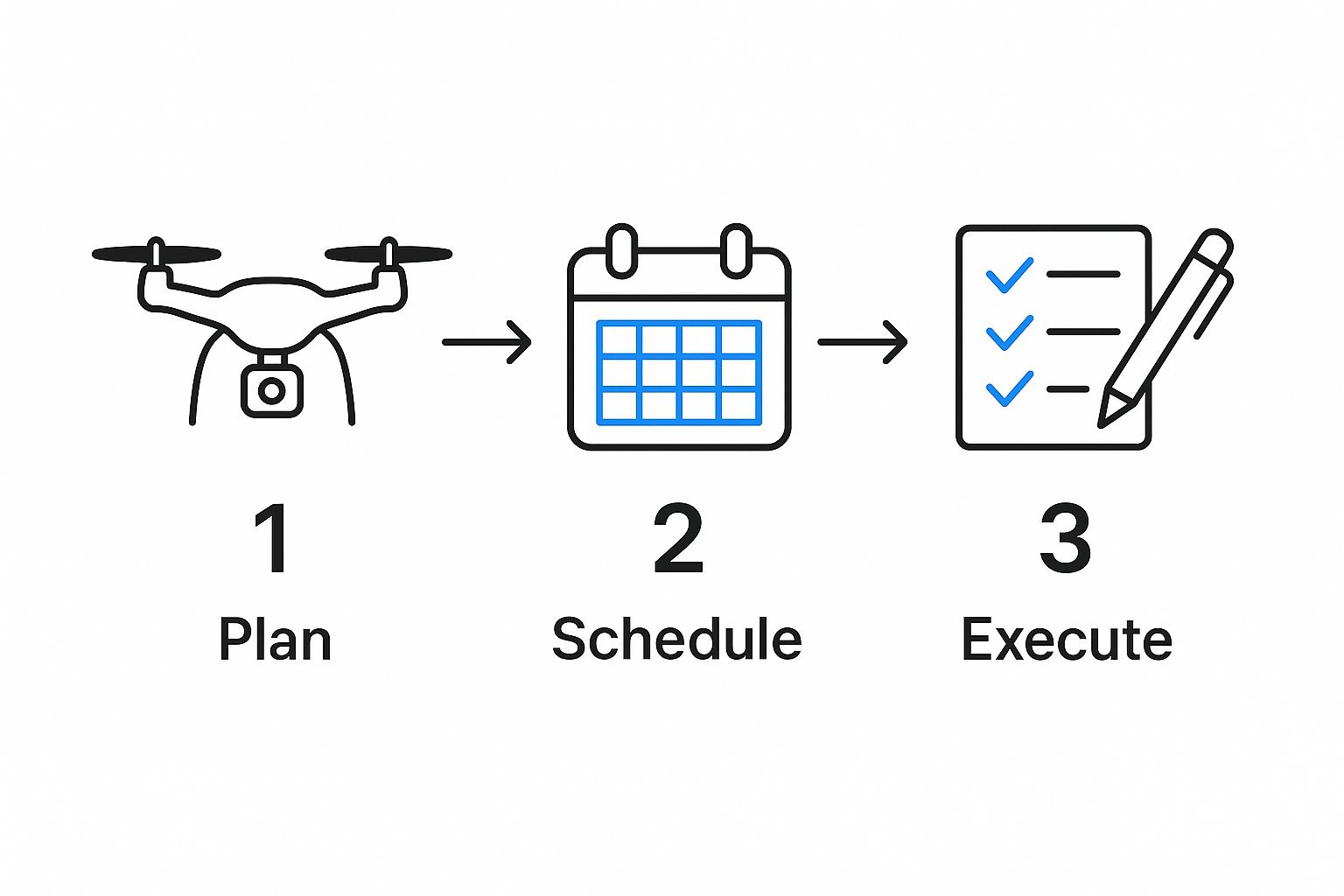
As you can see, it's a simple cycle: check, record, and review. This loop is the key to catching small issues before they become big, expensive problems.
Logging a Typical Mission
Alright, let's walk through a real-world example. Imagine you're flying a DJI drone for a commercial inspection. Your logging process will break down into what happened before, during, and after the flight.
First, your pre-flight entry. Before you even arm the motors, you document that you've done your due diligence. A quick note is all it takes: “10/26/2024 - Pre-flight check complete. All systems nominal. Props secure, gimbal calibrated. Battery ID: B_M3E_04 (Cycle #34) fully charged.”
Next, the post-flight data. Once the drone is safely on the ground, add the mission details. This includes flight time, location, and conditions: “Total Flight Time: 22 mins. Location: North Ridge Construction Site. Weather: 55°F, Wind NW 15mph. Max Altitude: 250 ft.”
Finally, and most importantly, your observations and notes. This is where you add the human element that data alone can't capture. For instance: “Post-flight inspection revealed minor scuff on Prop #2 (front-right). Motor temps normal. Battery landed at 22%. No flight anomalies.”
Your notes are the most valuable part of your log. They provide the human context that raw data lacks, helping you connect a specific flight condition to a future maintenance need.
This same "be specific" approach applies to routine maintenance. Instead of just writing "swapped props," a much more useful entry would be: “11/02/2024 - Replaced all four propellers after 50 flight hours per manufacturer recommendation. Old props archived for inspection.”
Same goes for firmware. Don't just say you updated it. Record the details: “11/05/2024 - Updated aircraft firmware from v09.01.0302 to v09.02.0403. Test hover completed, all systems functioning correctly.”
This level of detail is what transforms a simple notebook into a powerful, reliable, and incredibly useful tool from day one.
Weaving Your Logbook Into Your Daily Flight Workflow
A perfect drone maintenance log is useless if it just sits there collecting dust. The real challenge isn't just creating the log; it's making it a natural, unbreakable habit. Weaving logging into your daily flight operations is what turns this task from a chore into a seamless, professional practice.
The goal here is to make documentation feel as routine as charging your batteries. This all starts by capturing data during your pre-flight and post-flight checks. Instead of seeing them as separate tasks, think of them as the first draft of your log entry.
Making Pre-Flight and Post-Flight Checks Count
Your pre-flight check isn't just about safety—it's your first data point. As you inspect propellers, check battery levels, and verify gimbal movement, you're actively assessing the drone's condition. This is the moment to make a quick note, whether on a pocket pad or a digital app on your phone.
The same goes for when you land. A post-flight inspection should happen immediately after every single mission. This is when you'll spot the new scuff on the landing gear, hear a tiny change in a motor's sound, or notice a battery that feels a bit warmer than usual. Documenting these subtle observations is what transforms a simple record into a powerful predictive tool.
For pilots juggling multiple flights a day, it's worth looking at ways to automate data entry for your drone logbook. This can cut down on the manual work and seriously improve the accuracy of your records over time.
From Reactive Notes to Predictive Power
A truly effective drone maintenance log does more than just look backward; it helps you look forward. When you start analyzing your log data over weeks and months, you can shift from reactive repairs to predictive maintenance—a change that's defining the modern drone industry.
This proactive mindset is fueling massive growth. In 2023, the drone maintenance service market was valued at around USD 1.2 billion and is projected to climb to nearly USD 4.8 billion by 2032. This incredible jump is driven by the need for smarter maintenance as drones get more complex and take on more critical jobs.
The most valuable insights come from spotting subtle trends, and your logbook is the key. Is one battery consistently losing its charge capacity faster than the others? Is a particular motor showing higher temperatures after flights in cold weather? This is the kind of data that prevents catastrophic failures.
A practical way to use this data is by setting up automated reminders based on your logged flight hours. This turns your raw data into actionable maintenance triggers.
Every 50 flight hours: Time to inspect and likely replace propellers.
Every 100 flight hours: Perform a detailed motor bearing inspection.
Every 25 cycles: Deep cycle your batteries and test their health.
This system turns your flight time data into a real-world maintenance schedule. For complex jobs like utility inspections, where equipment reliability is everything, this level of detail is non-negotiable. Our guide on powerline inspection with UAVs shows just how vital this proactive approach is for both mission success and safety. By making these practices part of your workflow, your log becomes a living tool that ensures airworthiness and protects your investment.
Advanced Logging for Commercial Drone Fleets
When you scale up from a single aircraft to an entire commercial fleet, your logging approach has to evolve. It's no longer a personal habit—it becomes a critical business system. Once you're managing multiple aircraft and pilots, the stakes are just plain higher. The biggest challenge? Standardization. You have to ensure every single pilot logs data the exact same way to maintain consistency and compliance across the board.
Without a standardized system, your fleet's data quickly turns into a chaotic, unreliable mess. Imagine one pilot meticulously logging battery cycles while another forgets entirely. This kind of inconsistency makes it impossible to accurately compare aircraft performance or enforce a uniform maintenance schedule. A professional, unified drone maintenance log is your absolute foundation for operational excellence.
Standardizing Procedures for Team Consistency
To get that consistency, you need to create a clear, mandatory logging protocol for your entire team. This isn't a suggestion; it should define precisely what data to capture, the required format for entries, and the timing for all pre-flight and post-flight documentation. Make this a non-negotiable part of your standard operating procedures (SOPs).
For example, your SOP could mandate that all post-flight logs must be completed within 30 minutes of landing. The log must include specific data points, such as:
Aircraft and Pilot ID: Exactly which drone was flown and by whom.
Battery and Propeller IDs: Don't just track the drone; track the specific components to understand their lifecycle.
Flight Duration and Conditions: Automatic data is great, but a pilot's notes on unusual wind or unexpected weather are invaluable.
Maintenance Actions Taken: Any on-site fixes, like a quick propeller swap, must be logged immediately.
This structured approach takes the guesswork out of the equation and ensures every pilot contributes to a clean, usable dataset. It's also a massive part of building a strong safety culture. You can dive deeper into that in our guide on essential drone safety tips.
Leveraging Fleet Management Software
Trying to manage all of this manually is a recipe for headaches and errors. This is where dedicated drone fleet management software becomes an absolute game-changer. Platforms like AirData UAV or DroneLogbook can automate a huge chunk of this process. They sync flight logs directly from the controller, track component usage across your entire fleet, and can even automatically flag aircraft that are approaching maintenance thresholds.
In the event of an incident, a detailed, third-party log is your best defense. It provides impartial, time-stamped evidence of your maintenance history and pilot diligence for FAA audits or insurance claims.
These systems transform your drone maintenance log from a simple record into a powerful business asset. They give you the precise documentation you need to prove due diligence, build trust with clients by showcasing your professionalism, and, most importantly, minimize operational risk by keeping your entire fleet airworthy and accounted for.
Your Drone Maintenance Log Questions, Answered
Even with the best intentions, questions always come up when you start getting serious about logging your drone's maintenance. I get it. To help you out, I've put together some straightforward answers to the questions I hear most often from other pilots. This should help you stick to best practices and get the most out of your records.
How Long Should I Keep My Maintenance Logs?
There’s no single magic number, but my personal rule of thumb is to keep your logs for the entire operational life of the drone. Think of it as the drone's full service history. It’s absolutely invaluable for proving you've done your due diligence, diagnosing those tricky long-term issues, and it can seriously boost the aircraft's resale value.
If you’re a commercial operator, the stakes are higher. It's smart to hold onto all your maintenance and flight records for at least 24 months after the drone is retired or sold. This way, you're covered in case of an FAA audit or an insurance claim, which can sometimes pop up long after a job is finished.
Your logbook is a critical legal and financial document. Never toss it out prematurely, especially if you fly for your business. It's your number one piece of evidence showing a commitment to safety and professional standards.
Digital Or Paper Logs: Which Is Better?
Honestly, the best drone maintenance log is the one you’ll actually use consistently. Both digital apps and a classic paper notebook have their place, and the right choice really boils down to your personal workflow and the type of flying you do.
Digital Logs: These are powerful. They offer features like automatic data syncing, instant search, and cloud backups. If you're managing a fleet of drones and multiple pilots, going digital is a no-brainer.
Paper Logs: They're simple, they're reliable, and they don’t need batteries or an internet connection. For pilots who prefer a more hands-on approach, there’s something incredibly satisfying about keeping a tangible record.
At the end of the day, whether you choose a slick app or a simple spiral notebook, the quality of what you write inside is what truly matters.
What Is The Most Common Mistake To Avoid?
The single biggest mistake I see pilots make is being vague. Entries like "checked drone" or "replaced props" are practically useless. A log's real value comes from its specificity. Without detailed notes, you completely lose the ability to spot trends or provide any meaningful proof that maintenance was actually performed.
Always be specific. Instead of "fixed motor," your entry should look more like this: "Replaced front-left motor (Motor #1) due to audible bearing noise at 112 flight hours." For any commercial pilot, this level of detail is non-negotiable and ties directly into your risk management. In fact, understanding how maintenance and liability are connected is a huge part of getting the right drone business insurance to protect your aerial enterprise.
At JAB Drone, we believe that meticulous record-keeping is the bedrock of safe and successful flying. For more expert guides, in-depth reviews, and insights into the world of drone technology, explore our resources at https://www.jabdrone.com.
Comments