


Parts of a Drone: Complete Guide for Beginners

Updated: Jul 29, 2025
A modern drone is really a symphony of interconnected parts, with each one playing a critical role in getting it off the ground and keeping it in the air. At a high level, the main parts of a drone boil down to the structural frame, the propulsion system (motors and propellers), the flight controller or "brain," the power source (battery), and a host of sensors and communication systems.
The Anatomy of a Modern Drone
Ever wondered what truly makes a drone fly? It’s best to think of it not as a single machine, but as a high-tech flying organism where multiple systems work together in perfect harmony. Getting a handle on these core systems gives you a solid foundation for understanding how each individual component works its magic.
To simplify things, we can group the primary parts of a drone into a few key categories. Each one serves a distinct purpose, a lot like the different systems in a living body.
This simple hierarchy diagram breaks down a drone's core anatomy into its three foundational pillars: the physical structure, the system that creates movement, and the electronic components that provide intelligence and control.
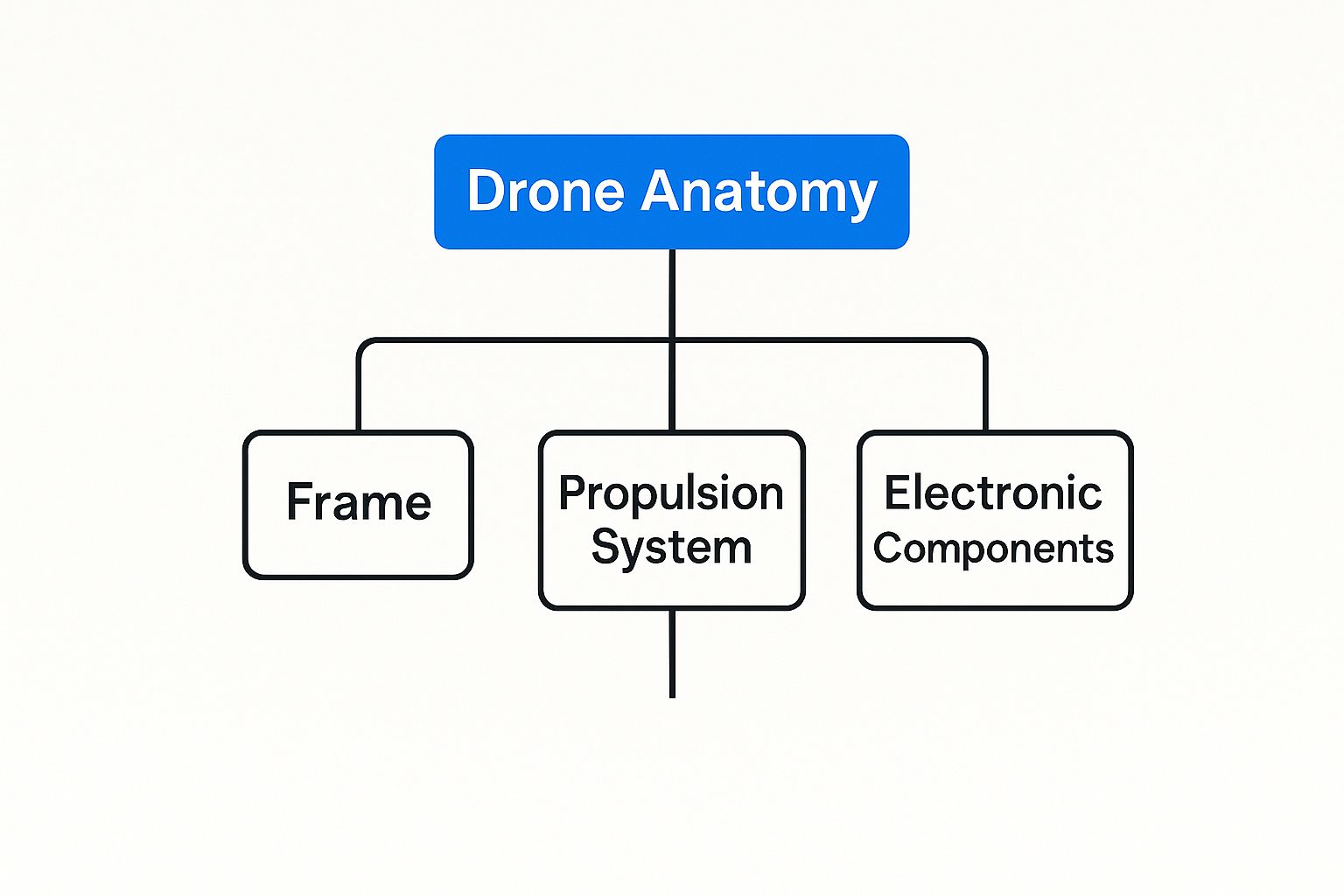
This visual shows how every single component falls under either the frame, propulsion, or electronics, illustrating just how interconnected everything is. Let's briefly introduce these systems using some simple analogies.
The Core Systems
First up, you have the frame, which you can think of as the drone's skeleton. It provides the physical structure that holds everything together. The choice of material for the frame—often lightweight carbon fiber or durable plastic composites—is a critical balancing act. A typical drone frame makes up 20-30% of its total weight, a crucial factor for achieving both durability and flight efficiency. You can find out more about the drone market and component breakdowns in this report from Grand View Research.
Next is the propulsion system—these are the muscles of the drone. This includes the motors and propellers, which work together to generate lift and move the drone through the air. Without this system, the drone is just a collection of electronics sitting on the ground. It's all potential with no power.
Finally, we have the electronic components, which function as the drone's brain and senses. The most important of these is the flight controller, a small but mighty computer that processes commands and sensor data to keep the drone stable. It’s supported by other vital parts like the battery (the heart), sensors (the eyes and ears), and communication systems that allow it to be controlled from a distance.
To make this crystal clear, here's a quick table breaking down the core components and their roles.
Core Drone Components and Their Functions
This table offers a quick-glance summary of the essential parts of a drone and the role each one plays in flight.
Component | Primary Function | Analogy |
|---|---|---|
Frame | Provides structural support and holds all parts together. | Skeleton |
Motors & Propellers | Generate lift and thrust to move the drone. | Muscles |
Flight Controller | Processes data and sends commands to the motors. | Brain |
Battery | Supplies power to all electronic components. | Heart |
Sensors | Gather data about the drone's orientation and environment. | Senses (Eyes & Ears) |
Radio Receiver | Receives commands from the pilot's controller. | Nerves |
Think of these parts as a team. The brain tells the muscles what to do, the skeleton supports them, and the heart provides the energy for it all to happen.
Key Takeaway: A drone isn’t just one part, but a collection of specialized systems. The frame provides structure, the propulsion system creates movement, and the electronics provide the intelligence to control it all.
This high-level overview gives you a map for the journey ahead. As we dive deeper, we'll explore each of these parts individually, revealing how they contribute to the incredible capabilities of modern drones.
The Frame: Your Drone's Skeleton
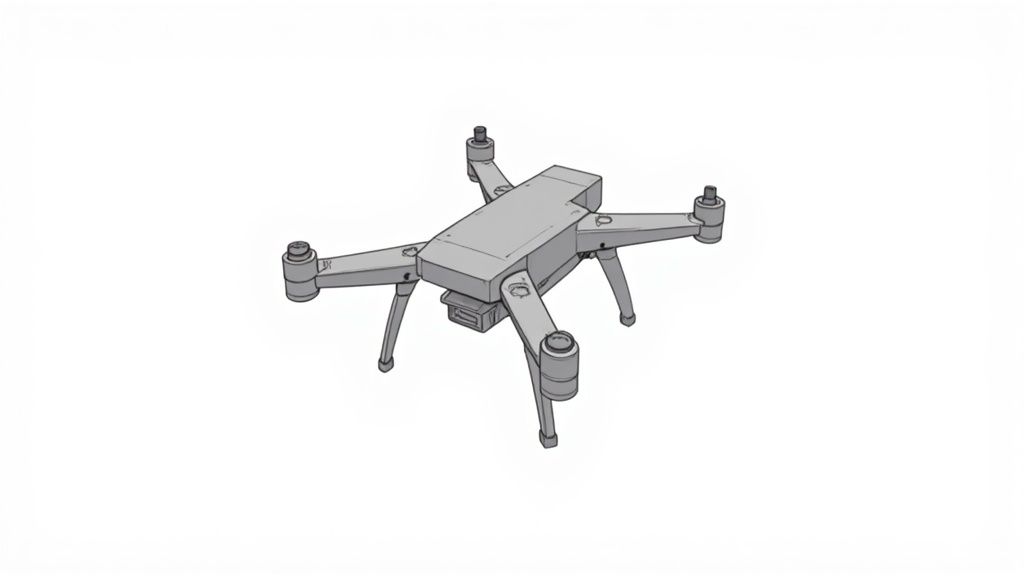
Every great build, whether it's a skyscraper or a high-performance machine, starts with a solid foundation. For a drone, that foundation is its frame. This is the skeleton that holds everything together—from the powerful motors to the delicate flight controller. It provides the core structure and shape the drone needs to get off the ground.
But the frame does so much more than just act as a mounting rack. Its design, material, and shape directly influence the drone's personality and purpose. It's a lot like the chassis of a car. A feather-light, minimalist chassis is perfect for a nimble sports car, while a heavy-duty, reinforced one is what you need for a rugged truck. Drone frames operate on the very same principle.
The material a frame is built from is one of its most critical characteristics. The choice always comes down to a trade-off between weight, durability, and, of course, cost.
Key Insight: Choosing a frame material is a balancing act. Lighter frames mean more agility and longer flight times. On the other hand, more durable materials can shrug off the inevitable crashes and hard landings—something every new pilot and aggressive FPV racer knows all too well.
Common Frame Materials
The most popular materials you'll run into each offer unique advantages for different flying styles. Getting to know them helps you understand why a high-end photography drone and a budget-friendly toy drone are built so differently.
Carbon Fiber: This is the gold standard for most serious hobbyist and professional drones. It has an incredible strength-to-weight ratio, which makes it both ridiculously strong and rigid without piling on the grams. This makes it the go-to choice for FPV racing and freestyle drones that need to be both quick and tough.
Plastic (ABS): You'll find plastic on most toy drones and some entry-level camera drones. It's cheap and easy to mold into complex shapes. While it's not nearly as strong or light as carbon fiber, it’s a cost-effective option for pilots who are just getting their wings.
Aluminum: Sometimes used for specific parts like landing gear or motor mounts, aluminum is stronger than plastic but heavier than carbon fiber. It's often mixed into hybrid frames to add extra rigidity in key stress points without the price tag of a full carbon build.
Frame Configurations and What They Mean
Beyond the material, the frame's shape—specifically the number of arms—defines its configuration. This layout is a huge deal, as it directly impacts the drone's lift capacity, stability, and even its ability to survive a mid-air failure.
The most common setup you'll see everywhere is the quadcopter, which has four arms and four motors. This design hits a sweet spot, offering an excellent balance of power, efficiency, and simplicity. It's no wonder it's the go-to for everything from FPV racing to aerial photography.
Another popular configuration is the hexacopter, with its six arms and motors. Those two extra motors provide a serious boost in lifting power, allowing the drone to carry heavier payloads like professional cinema cameras. They also create redundancy. If one motor fails, a hexacopter can often stay in the air long enough to land safely—a crucial feature when your expensive gear is on the line. Following that same logic, an octocopter with eight arms provides even more lift and safety for high-stakes commercial and industrial jobs.
The Propulsion System: Generating Lift and Movement
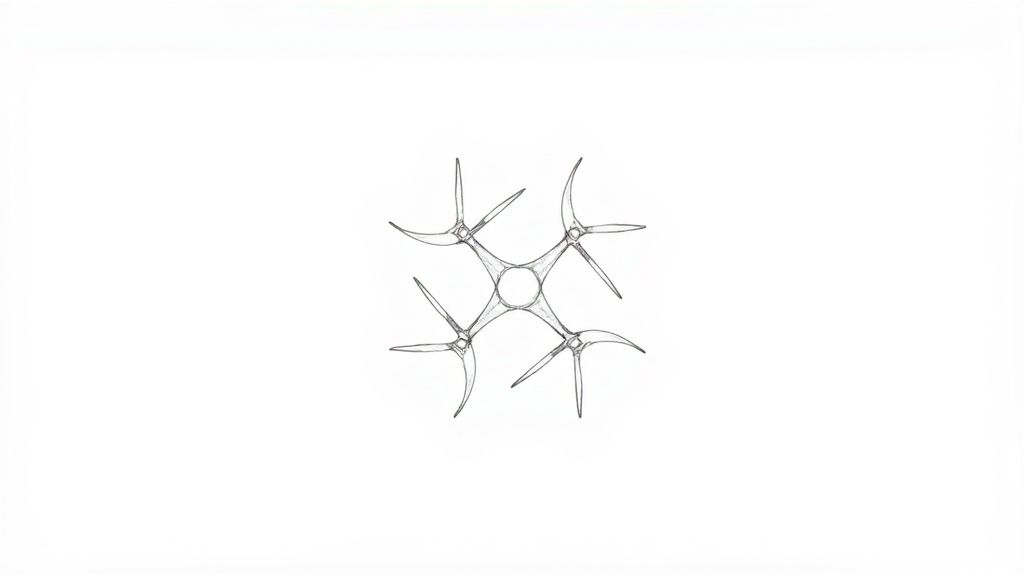
If the frame is your drone's skeleton, the propulsion system is its powerful heartbeat and muscular system all rolled into one. This dynamic trio of components is responsible for generating the raw force needed to get your drone off the ground and move it through the air with precision. These are the active parts of a drone that bring it to life.
Think of it like a high-performance vehicle. The motors are the engine, converting electrical energy from the battery into potent rotational force. The propellers are the tires, gripping the air instead of asphalt to push the drone up and forward. And finally, the Electronic Speed Controllers (ESCs) act as the throttle, meticulously translating commands from the flight controller into the exact amount of power each motor receives.
This perfectly synchronized dance between these three parts is what allows a drone to hover in place, punch the throttle for a rapid ascent, or execute a razor-sharp turn. When you tell the drone to fly forward, the rear motors spin faster, tilting the entire craft and propelling it ahead. It's a constant, high-speed balancing act.
Motors: The Powerhouses
At the very core of this system are the motors. In the world of drones, you'll really only run into two types, but one completely dominates any serious application.
Brushed Motors: These are the simpler and cheaper option, which is why you'll often find them in toy-grade drones. They use physical carbon brushes to pass power to the motor, but these brushes wear out over time, making them less reliable and efficient.
Brushless Motors: This is the gold standard for pretty much all hobbyist and professional drones. They are far more efficient, powerful, and durable because they have no brushes to wear down. This design gives them superior performance and a much longer lifespan, making them the undisputed king.
The quality and power of these motors are absolutely paramount, and their cost reflects that. In fact, propulsion motors and batteries can represent up to 40% of a drone's hardware cost, a number that underscores just how much value is placed on flight duration and power efficiency.
Propellers: The Wings of Flight
Propellers, or "props" as they're called in the community, are the airfoils that actually generate thrust. Their specific design has a massive impact on how a drone behaves in the air. It all comes down to two key factors.
Key Takeaway: Propeller size (diameter) and pitch (the distance it moves forward in one rotation) create a classic trade-off. Larger props with a lower pitch are fantastic for stability and efficiency, making them perfect for capturing smooth, cinematic aerial video. Smaller props with a higher pitch offer more agility and speed, which is exactly what you want for drone racing and freestyle acrobatics.
Choosing the right propellers is crucial for getting peak performance, and knowing when they need a little TLC is just as important. For a much deeper look into this, check out our guide on how a [drone propeller replacement](https://www.jabdrone.com/post/drone-propeller-replacement-boost-your-drone-s-flight) can seriously boost your drone's flight capabilities. These spinning blades are the drone's direct connection to the air, making them one of the most vital parts of a drone for controlled flight.
Here is the rewritten section, crafted to sound like an experienced human expert and match the provided writing style examples.
The Flight Controller: The Brain of the Operation
If the frame is the skeleton and the motors are the muscles, then the Flight Controller (FC) is, without a doubt, the drone's brain. This small, unassuming circuit board acts as the central nervous system, connecting and commanding every other component. It’s the magic black box where raw sensor data is transformed into intelligent action, turning a pile of parts into a responsive, high-performance flying machine.
Think of the FC as a tiny pilot with lightning-fast reflexes sitting in the cockpit. It receives your commands from the remote, processes a constant flood of data from its onboard sensors, and then fires off precise instructions to the Electronic Speed Controllers (ESCs). This all happens thousands of times a second, a nonstop stream of micro-adjustments that keeps the drone perfectly stable and obedient to your every move.
The secret to this incredible stability is a critical chip found on every flight controller: the Inertial Measurement Unit (IMU).
The Inner Ear of the Drone
The IMU is basically the drone's sense of balance, working much like the inner ear does for humans. It’s not just one sensor, but two critical sensors working in perfect harmony:
Gyroscope: This sensor is all about rotation. It measures how fast the drone is tilting on its pitch (forward/backward) and roll (side-to-side) axes, and how quickly it's turning on its yaw (left/right) axis. It tells the FC, "Hey, we're tilting this fast!"
Accelerometer: This sensor measures linear movement, including the constant, undeniable pull of gravity. It’s what helps the FC understand which way is down, preventing your drone from deciding to fly upside down unexpectedly.
These two sensors feed a continuous river of data to the flight controller's processor. The processor crunches the numbers and calculates the exact adjustments needed to either hold a perfectly level hover or execute a sharp, aggressive maneuver. It’s a seamless feedback loop that happens so fast it feels like pure instinct.
The Software That Gives It Personality
While the hardware provides the raw physical capability, it’s the flight firmware—the software running on the FC—that truly gives a drone its unique personality. This is how you can take the same set of components and tune it to be either a gentle, cinematic flyer or a screaming, acrobatic beast.
Key Insight: Flight firmware is the bridge between what you want the drone to do and what the hardware actually does. By tweaking settings like PIDs (Proportional, Integral, Derivative) and rates, you can fundamentally change how the drone feels—how sharply it reacts, how aggressively it self-levels, and how it carves through corners.
A couple of the most popular open-source firmware options dominate the scene:
Betaflight: This is the undisputed champion for FPV racing and freestyle flying. It's built from the ground up for raw performance and is always pushing the envelope with new features.
ArduPilot: A incredibly powerful and versatile platform, ArduPilot is the go-to for autonomous missions and professional work. It supports not just multicopters but also rovers, planes, and more.
The sophistication of these systems is a major force driving the entire drone industry forward. In fact, the autonomous drone market—which leans heavily on advanced flight controllers running complex AI algorithms—is projected to hit $25.24 billion in 2025. These powerful brains are what make complex jobs like automated package delivery and large-scale infrastructure inspection possible. You can get a deeper look at this trend in this drone industry innovator's guide. At the end of the day, this brain is one of the most vital parts of any drone.
Power and Communication Systems: Staying Airborne and Connected
A drone is a marvel of modern engineering, but without power and a solid link to its pilot, it’s just an expensive paperweight. The power and communication systems are the unsung heroes of any drone build, the essential lifelines that keep it flying, responsive, and connected to you.
Think of the battery as the drone's heart, pumping life-giving electricity to every single component. The communication system, on the other hand, is its nervous system, instantly carrying critical commands from your hands to the drone's brain.
The Powerhouse: The Drone Battery
The absolute workhorse of modern drone power is the Lithium Polymer (LiPo) battery. Drone pilots love LiPo batteries because they cram a massive amount of energy into a lightweight package—a perfect recipe for anything that needs to defy gravity. But to really get the most out of your drone (and do it safely), you need to understand their key specs.
Voltage (V) and S-Rating: Voltage is the raw power output of the battery. You'll usually see it expressed as an "S-rating," where each "S" represents one 3.7V cell. A 4S battery (14.8V) will deliver more juice than a 3S battery (11.1V), spinning the motors faster and giving you more aggressive performance.
Capacity (mAh): Measured in milliamp-hours, this is basically your fuel tank. A 5,000mAh battery can supply power for a longer time than a 2,200mAh one, which directly translates to longer flight times.
Discharge Rate (C-Rating): This spec tells you how fast the battery can safely dump its energy. A high C-rating is non-negotiable for racing and freestyle drones that demand sudden, powerful bursts of speed. For a drone that’s just taking gentle aerial photos, a lower C-rating is perfectly fine.
Key Takeaway: Picking the right battery is a careful balancing act. You have to match the voltage to your drone’s electronics, then weigh the trade-off between higher capacity (for longer flights) and lower weight (for more agility).
The Communication Link: Radio Systems
The communication system is a two-way street. It’s what lets you send commands to the drone and, in most setups, get critical data back from it. This invisible connection is managed by a few key pieces of hardware.
First up is the Transmitter (Tx)—that’s the remote controller you hold in your hands. When you move the control sticks, the transmitter converts your physical movements into a digital radio signal.
That signal is then caught by the Receiver (Rx), a tiny component with antennas on the drone itself. The receiver decodes the signal and feeds the instructions to the flight controller, which then tells the drone what to do. This link is so critical that many pilots must register their aircraft with aviation authorities; you can learn all about it in our [complete guide to FAA drone registration](https://www.jabdrone.com/post/drone-faa-registration-your-complete-stress-free-guide).
For First-Person View (FPV) pilots, there’s a third, equally crucial part of the puzzle: the Video Transmitter (VTX). This little component grabs the live video feed from the drone's camera and broadcasts it on a specific frequency. This is what allows you, the pilot, to see what the drone sees in real-time through FPV goggles. It’s the VTX that creates that immersive, in-the-cockpit feeling that makes FPV flying so incredibly thrilling.
What Carries the Camera and Other Gear
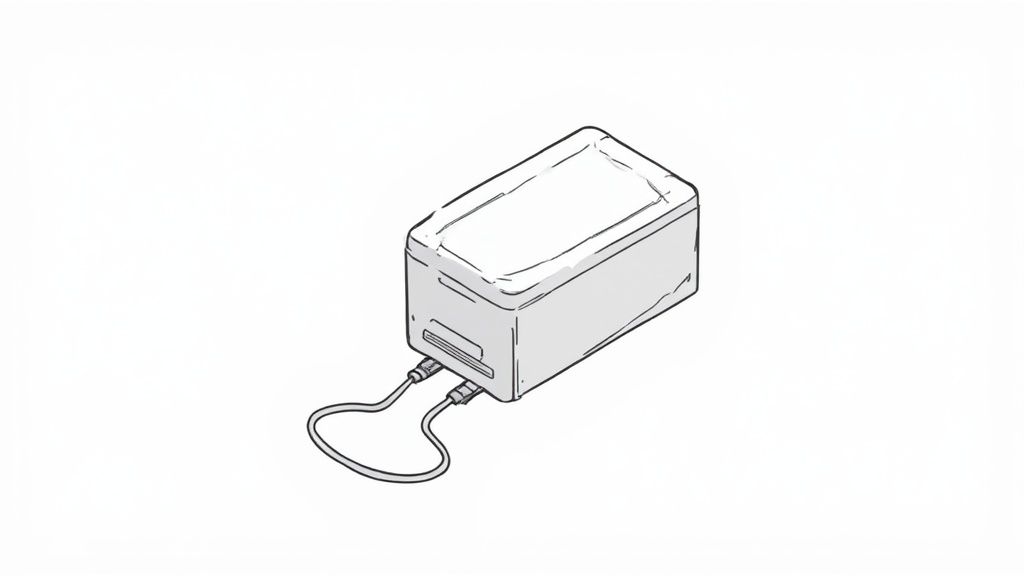
While the frame, motors, and flight controller are what get a drone into the air, it’s the payload that gives it a job to do. Think of the drone itself as a powerful delivery truck; the payload is the precious cargo it's carrying, turning a simple flying machine into a valuable tool for filmmaking, inspections, or even delivering packages.
By far, the most common payload is a camera. From stunning 4K cinematic video to crisp, high-resolution photos, cameras are what made drones an essential part of the toolkit for content creators and videographers.
But a camera is pretty useless if the footage is a shaky, unwatchable mess. That's where the gimbal comes in.
A gimbal is a brilliant piece of engineering that uses its own set of tiny motors and sensors to keep the camera perfectly level and steady. As the drone zips through the air, tilting, rolling, and vibrating, the gimbal instantly cancels out those movements. The result? Flawlessly smooth video that looks like it was shot from a tripod floating in the sky. For any kind of aerial imaging, it’s one of the most critical parts of a drone.
The Gimbal: Keeping Your Shot Rock-Steady
The gimbal is the secret sauce for professional-quality footage. It’s what isolates your camera from all the bumps and shakes of flight, guaranteeing a stable, clear picture no matter how your drone is moving.
2-Axis Gimbal: This type stabilizes the camera on two axes—pitch (up and down) and roll (side to side). It’s a decent entry-level option, but it won't correct for yaw (left and right) movements. This can sometimes lead to slightly wobbly footage when you’re making turns.
3-Axis Gimbal: This is the industry standard for virtually all modern photography and cinema drones. It stabilizes on all three axes (pitch, roll, and yaw), delivering that buttery-smooth video we all love, even during complex flight maneuvers.
To really get a feel for how the camera and gimbal work together, and what to look for in a new drone, check out our guide on [understanding drone sensors and camera capabilities](https://www.jabdrone.com/post/understanding-drone-sensors-and-camera-capabilities). It’s a deeper dive into the tech that captures those incredible aerial views.
More Than Just Cameras
While cameras get most of the spotlight, drones can be outfitted with a huge variety of specialized equipment for specific jobs. In many ways, the payload is the job.
Key Insight: A drone’s real value comes from the data it can gather. The payload is the specific tool used for that data collection, whether it’s visual, thermal, or agricultural.
Some of these specialized payloads include:
Thermal Cameras: Used by firefighters to see through smoke and by building inspectors to spot heat loss.
Multispectral Sensors: Deployed in agriculture to analyze crop health by capturing light invisible to the human eye.
LIDAR Scanners: Used to create incredibly detailed 3D maps of terrain for surveying and construction projects.
Package Delivery Systems: As seen with services like Amazon Prime Air, specialized clamps and containers let drones deliver goods weighing up to 5 pounds directly to a customer's backyard.
Common Questions About Drone Parts
Alright, we’ve torn down a drone piece by piece, from the frame holding it all together to the flight controller that acts as its brain. But knowing the parts list is one thing. The real magic happens when you understand how to make smart choices about those parts in the real world.
Let's dig into the questions that pop up most often once you move past the theory and start thinking about actually flying.
One of the first big decisions you'll face is whether to build a drone from scratch or just buy a pre-built, ready-to-fly (RTF) model. If you go the DIY route, you're signing up for an incredible learning experience. There's no better way to get an intimate understanding of how every single component talks to the others. It takes patience and a willingness to get your hands dirty, but the payoff in knowledge is huge.
On the flip side, RTF drones are all about convenience. You can literally be up in the air minutes after opening the box. This makes them the perfect choice if your main goal is to start flying immediately, not to spend your weekends with a soldering iron.
Prioritizing Parts For Your Flying Style
Here’s a critical piece of advice: not all drone parts are created equal, especially when it comes to your specific mission. What you plan to do with your drone should dictate where you spend your money. The setup for a cinematic videographer looks completely different from what a competitive FPV racer needs.
Think about it this way:
For Aerial Photography: Your money should go straight to the camera and the gimbal. A high-resolution sensor paired with a buttery-smooth 3-axis gimbal is what separates shaky, amateur footage from professional-grade video. After that, a stable frame and efficient motors for longer flight times are your next priority.
For Drone Racing: Speed and toughness are the name of the game. Your focus should be on a lightweight carbon fiber frame that can take a beating, powerful brushless motors for instant acceleration, and responsive ESCs to handle the rapid changes in power. The camera here is purely functional—it's all about a low-latency FPV feed, not cinematic beauty.
Key Takeaway: You don't need the absolute best of every single part. Figure out your primary goal and invest your budget in the components that directly impact it. You'll get much better results, whether that's capturing breathtaking shots or shaving milliseconds off your lap time.
How Much Should You Invest in Quality Parts
The price range for drone components is massive, but investing in quality where it counts will pay you back every time you fly, both in performance and peace of mind. Your flight controller and propulsion system (the motors and ESCs) are the absolute heart and brain of your aircraft. Skimping here is a recipe for unreliable flight, glitches, and even crashes.
Sure, a basic frame might get you airborne as a beginner, but a well-made one provides a much more stable and reliable platform for everything else.
Ultimately, your budget is your guide. But always remember that a well-built drone with dependable core components will give you a far better, and safer, experience. Once your bird is assembled and you’re ready for takeoff, mastering the controls is the final step. Our guide on how to fly a drone for beginners offers easy flight tips to get you started confidently and safely.
Comments