


How to Dispose of a LiPo Battery The Safe Way

Updated: Aug 11, 2025
Tossing a dead LiPo battery into the trash might seem like the easy way out, but it's a seriously dangerous mistake. To get rid of a LiPo properly, you absolutely must first fully discharge it to zero volts. Only then can you take it to a certified battery recycling facility or a local hazardous waste collection site. Whatever you do, never just chuck them in your household garbage or recycling bins.
Why You Can't Just Throw LiPo Batteries Away
It's tempting to treat a depleted LiPo like any other piece of trash, but its internal chemistry makes it a hidden hazard long after it stops powering your drone. Unlike a standard AA battery, a Lithium Polymer (LiPo) battery stays volatile even when it seems completely dead. The real danger is its potential for a violent reaction if it gets damaged.
The Hidden Fire Risk in Your Trash
Think about what happens in a garbage truck. The compactor or the heavy machinery at a landfill can easily puncture or crush a LiPo's soft outer shell. This kind of damage can cause an internal short circuit, kicking off a chain reaction called thermal runaway—a rapid, uncontrolled release of energy.
We're not talking about a small spark here. This can lead to an intense, self-fueling fire that's notoriously difficult to put out. These chemical fires are a huge risk to sanitation workers and can ignite massive blazes at waste management facilities. Understanding the chemistry behind different lithium batteries, like a high-voltage LFP battery, really drives home how serious these hazards are. If you want to dive deeper, you can Learn more about the components of high-voltage LFP batteries and see what makes safe disposal so critical.
Beyond the Flames: An Environmental Toll
The danger doesn't stop with fire. LiPo batteries are packed with materials that are seriously harmful to the environment. When they're left to rot in a landfill, their casings eventually break down, leaching toxic chemicals and heavy metals straight into the soil and groundwater.
Improper disposal is a direct contribution to electronic waste (e-waste), which is a massive global problem. These batteries contain valuable and finite resources that are just lost forever when they're thrown away.
The scale of the problem is staggering. A mind-boggling 8 million tons of battery waste is generated every year, yet as of 2022, only about 5% of the world's lithium-ion batteries were actually recycled. This habit not only pollutes our planet but also drives the need for new mining operations to pull metals like lithium and cobalt from the earth, which has its own massive environmental footprint.
Responsible disposal is about more than just dodging a fire; it’s a key part of being a sustainable hobbyist. Taking the right steps protects both people and the planet. For a full rundown on battery safety, from charging to storage, check out our LiPo battery safety guide with essential tips that actually work.
Getting Your LiPo Battery Safely to Zero Volts
Before you can even think about recycling a LiPo battery, you need to drain it completely. A charged LiPo is like a tiny, contained bundle of energy. Your job is to safely bleed that energy out until the battery is totally inert. When a multimeter reads 0V, that battery is significantly safer to handle and transport, which is a non-negotiable step before disposal.
The process of taking a battery from a potential fire hazard to a properly recycled component is crucial. This is about more than just checking a box; it's about preventing real-world risks.
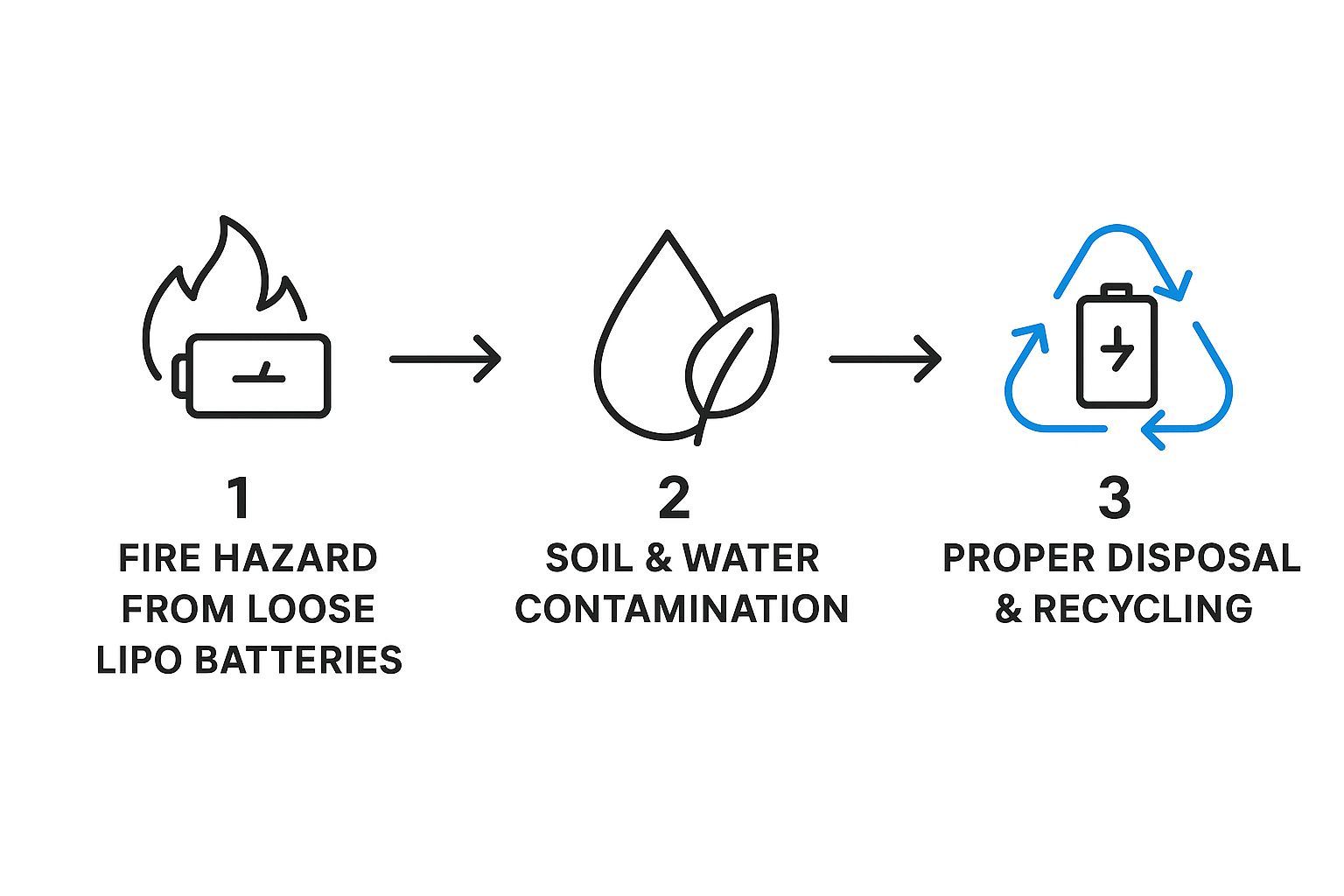
As you can see, improper handling can lead to fires and environmental harm. Taking the right steps ensures these powerful little packs are routed back into the resource stream safely.
There are a few solid ways to get this done. Let's walk through the most common methods, from the most controlled to the most controversial.
Use a Smart Charger with a Discharge Function
By far, the most controlled and reliable way to discharge a LiPo is with a modern smart charger. If you're in the RC hobby, chances are your charger has a dedicated "Discharge" or "Storage" function. While the storage setting only brings the voltage down to a safe 3.8V per cell, the full discharge function will take it much, much lower.
It's pretty straightforward. Just hook up your battery, navigate your charger's menu to the discharge setting, and let it handle the rest. The charger will manage the current safely and stop on its own. The only catch? Most chargers won't take a battery all the way down to 0V for safety reasons, so you'll likely need another method to finish it off completely.
Build a DIY Light Bulb Discharger
A classic, effective, and popular DIY method is the good old-fashioned light bulb. This low-tech approach gives you a fantastic visual cue—when the light goes out, you know the battery is just about empty.
Here’s what you’ll need to put one together:
A low-wattage 12V automotive light bulb, which you can find at any auto parts store.
Some wires with the right connectors for your battery (like an XT60 or Deans plug).
A LiPo voltage checker or multimeter to keep an eye on the progress.
All you have to do is solder the bulb to the wires and connector. It’s a simple circuit. When you plug in the LiPo, the bulb lights up and starts drawing power. Put the whole setup in a fireproof container—a LiPo bag or even a metal bucket works well—and keep an eye on it. Once that bulb flickers out, the battery is almost completely drained.
Safety First: I can't stress this enough: never leave a discharging battery unattended. Do this outside on a non-flammable surface like concrete, far away from anything that could catch fire. And if you have a puffed or damaged battery, do not use this method.
The Controversial Saltwater Bath Method
You'll see the saltwater bath recommended all over the internet, but honestly, it’s a method with some serious downsides. The idea is simple: you submerge the battery in a saltwater solution, which creates a slow short-circuit and drains the charge.
While it sounds easy, the process corrodes the battery's terminals and can release nasty gasses like chlorine. It’s not something you want to be breathing in. If you absolutely must go this route, make sure you do it in a very well-ventilated outdoor space.
This should be a last-resort option for healthy batteries only. Never, ever try this with a puffy or physically damaged LiPo. Piercing the casing is incredibly dangerous, and this method just isn't worth the risk.
For safer and more reliable results, you’re much better off sticking with a smart charger or the light bulb rig to fully neutralize your battery before you move on to disposal.
Comparing LiPo Battery Discharge Methods
Choosing the right discharge technique comes down to balancing safety, speed, and the gear you have on hand. This table breaks down the most common approaches to help you decide which one is the best fit for your situation.
Discharge Method | Safety Level | Relative Speed | What You Need |
|---|---|---|---|
Smart Charger | Very High | Moderate to Fast | Smart charger with discharge function |
Light Bulb Rig | High | Slow to Moderate | 12V bulb, wires, connectors, fireproof container |
Saltwater Bath | Low | Very Slow | Bucket, salt, water, well-ventilated outdoor area |
Each method will get the job done, but as you can see, the safety and equipment needed vary quite a bit. A smart charger is the gold standard for control, while the light bulb method is a reliable, low-cost alternative. The saltwater bath remains a risky, last-resort option that most experienced hobbyists avoid.
Preparing the Discharged Battery for Safe Transport
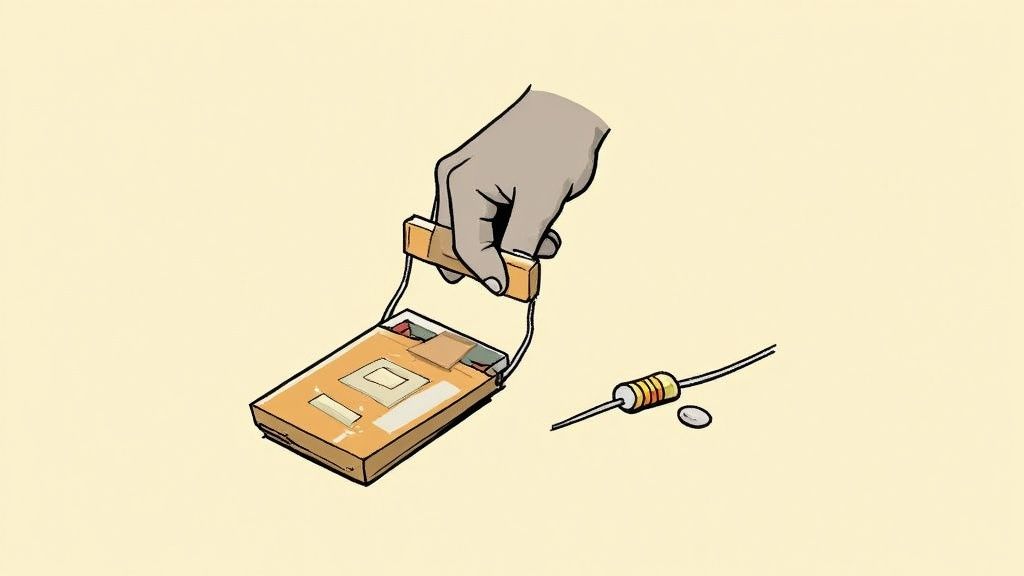
Alright, so you've successfully brought your LiPo down to zero volts. Great job. But you can't just toss it in a bag and head out the door. The last leg of this battery's journey—the trip to the recycling center—requires one final set of safety precautions to make sure it stays completely inert.
First things first, let's talk connectors. Even a "dead" battery can hold a tiny residual charge or get zapped by static electricity. To kill any chance of an accidental short circuit, you absolutely must cover the main power and balance connectors completely with electrical tape. It’s a small, simple step, but it's critical. This prevents those metal ends from touching anything they shouldn't, like another battery or the loose change in your car's cup holder.
Isolate and Contain Each Battery
Never, ever transport multiple LiPos by just throwing them into the same box or bag. It’s a recipe for disaster. If the tape on one connector comes loose, it could easily make contact with another, and you're right back to a dangerous situation. Each battery needs its own personal space.
An easy and effective solution is a heavy-duty ziplock bag. Pop each taped-up battery into its own bag, and you've effectively isolated it. This simple precaution is a huge part of responsible battery handling, which extends from its very first charge to its final disposal. In fact, consistent care is key, and our guide on caring for LiPo batteries offers expert tips to keep them safe throughout their entire lifecycle.
Remember, the goal is to make the battery as harmless as possible for its journey. Think of it as decommissioning equipment—every step is designed to reduce risk until it reaches its final destination at a certified facility.
Short-Term Storage Before Recycling
Life gets busy, and it’s not always practical to make a special trip to the recycling facility the second your battery is prepped. If you need to hang onto the discharged battery for a few days, here’s how to do it safely:
Cool and Dry Location: Keep the bagged battery somewhere out of the way and away from extreme temperatures. A shelf in the garage is a far better spot than a hot car or a damp basement.
Away from Flammables: This one’s a no-brainer. Store it far away from anything that could easily catch fire, like piles of paper, gasoline cans, or scrap wood.
Use a Fireproof Container: For an extra layer of peace of mind, place the individually bagged battery inside a fireproof box. A metal ammo can (with the rubber seal removed to prevent pressure buildup) or a dedicated LiPo-safe bag is perfect for this.
Follow these straightforward steps, and you can be confident that you’re transporting your old LiPos responsibly and, most importantly, safely.
How to Find a Local LiPo Recycling Center
So, you’ve done the hard part. Your battery is fully discharged, safely taped up, and ready for its final journey. But where does it actually go? This is the critical last step, and you can’t just toss it in your curbside recycling bin. LiPo batteries need to go to a facility that’s specifically equipped to handle their unique chemistry.
Luckily, finding a legitimate drop-off location is much easier than it used to be. A few excellent online tools can do most of the heavy lifting for you.
Start with Online Recycling Locators
Your first move should be to check the dedicated battery recycling directories. These services have massive, searchable databases of participating drop-off sites all over the country, saving you the headache of calling around blindly.
Call2Recycle: This is probably the most well-known and comprehensive program out there. Just pop your zip code into their website, and it’ll spit out a map of nearby locations, which often include big retail stores and municipal facilities.
Earth911: Another fantastic resource. Earth911 covers recycling for all sorts of materials, not just batteries. Its search tool is simple to use and can help you pinpoint specialized e-waste handlers in your area that know what to do with a LiPo.
These tools are incredibly helpful, but I always recommend calling the location before you make the trip. Store policies can change, and a quick phone call can save you from a wasted drive.
Think Local and Check Your Community
Sometimes the best resources are the ones hiding in plain sight right in your own neighborhood. Don't forget about the local businesses and services that handle electronics and hazardous materials on a daily basis.
Your local RC hobby shop, for instance, is often a goldmine of information. The staff deals with LiPos every single day. Even if they don’t have a take-back program themselves, they almost always know who does. They’re your best source for practical, on-the-ground knowledge.
Pro Tip: When you call a potential location, be specific. Ask, "Do you accept loose Lithium Polymer or LiPo batteries for recycling?" Some programs are only set up for cell phone or laptop batteries, so confirming this detail is key to avoiding a mix-up.
Another great option is to check with major electronics retailers. Stores like Best Buy often have prominent recycling kiosks right at their entrance for various electronics, and many include bins for rechargeable batteries. A quick call or a look at their corporate website will tell you if they accept hobby-grade LiPos.
Finally, don’t overlook your local municipality. Most cities or counties run a household hazardous waste (HHW) program. A quick search for "[Your City] hazardous waste disposal" will usually take you to their website, which lists drop-off locations and special collection event dates for things that can't go in the regular trash—and that definitely includes LiPo batteries.
The global push to recycle these batteries is huge. While local efforts might seem small, it's estimated that global lithium-ion battery recycling rates hit around 59% in 2023, driven largely by massive infrastructure in Asia. The valuable minerals inside, like cobalt and lithium, make recycling economically smart, and current tech can already recover over 90% of these materials. You can discover more insights about the global battery recycling landscape at sustainabilitybynumbers.com to see how your small effort fits into the bigger picture. When you take your battery to the right place, you’re playing a part in a critical circular economy.
The Booming Business of Battery Recycling
When you take a few minutes to figure out how to dispose of a LiPo battery the right way, you're doing a lot more than just preventing a fire. You’re tapping into a massive, rapidly growing global industry that’s being shaped by some serious economic forces. This isn't just about managing waste—it's about recovering critical resources on an incredible scale.
That small act of recycling your old drone or RC battery connects directly to the supply chain for some of the planet's most in-demand tech.
The EV and Energy Storage Explosion
The biggest engine firing up this recycling boom is the meteoric rise of electric vehicles (EVs) and large-scale energy storage systems. Every EV cruising down the highway carries a hefty lithium-ion battery pack, and the consumer appetite for them is only growing. This has created a hunger for the raw materials inside those batteries like we've never seen before.
Recycling facilities have essentially become "urban mines," capable of harvesting valuable materials from batteries that have reached the end of their life. These recovered materials are then reintroduced into the manufacturing cycle, helping to build a more circular economy. It’s a smart way to sidestep the huge environmental and financial toll of traditional mining.
The numbers don't lie. The global lithium-ion battery recycling market is on a trajectory to leap from roughly $16.23 billion in 2024 to a staggering $56.87 billion by 2032. That's a clear signal of a fundamental shift in how we see the value in old electronics.
This incredible expansion, growing at a compound annual rate of about 17%, is a direct response to the global demand for cleaner energy and transportation. The industry's growth isn't just a fleeting trend; it’s a deep-seated economic realignment as the world modernizes.
Recovering Precious Metals
So, what exactly makes these spent batteries so valuable? It all comes down to the cocktail of metals packed inside. A single LiPo battery is a dense little treasure chest of sought-after elements.
Cobalt: A key, and often pricey, component in battery cathodes. Cobalt mining is notoriously plagued with ethical and environmental headaches, so recycling offers a much more sustainable alternative.
Nickel: Another vital cathode material whose price can be all over the place. Pulling it from old batteries helps create a more stable supply chain for new manufacturing.
Lithium: Despite the name, recovering pure lithium is a complex technical challenge. However, new methods are making it more and more practical and economically worthwhile.
This drive for resource recovery isn't just happening with batteries. Many industries, including the commercial drone sector, are focused on improving sustainability and securing their supply chains.
By recycling your LiPo, you're making sure these finite resources don't end up wasted in a landfill. Instead, you're helping fuel the next wave of technology, turning a small, responsible choice into a piece of a much larger, economically critical cycle.
Got Questions About LiPo Battery Disposal?
Even when you think you have the process down, disposing of a LiPo battery can still throw a few curveballs your way. Let's run through some of the most common—and sometimes urgent—questions I hear from pilots. Here are some straight-up, no-nonsense answers to help you handle these situations the right way.
Can I Just Toss a Discharged LiPo in the Trash?
Let me be crystal clear: absolutely not. Never, under any circumstances, should a LiPo battery end up in your regular household garbage, even if you've drained it down to zero volts.
Think about the powerful machinery in garbage trucks and at landfills. That equipment can easily crush or puncture the battery's soft casing. A puncture, even on a "dead" battery, can still cause a chemical reaction and spark a nasty fire. These batteries are also full of hazardous materials you don't want leaking into the soil and groundwater. The only safe place for them is a designated battery recycling facility.
What Should I Do with a Puffed or Swollen LiPo?
A swollen or "puffy" LiPo is a huge red flag. It’s a clear sign of an internal failure, making the battery unstable and putting it at a high risk of bursting or catching fire. If you see this, do not try to charge it, discharge it, or use it in any way.
Your first priority is to get it to a safe place, immediately. Carefully move the battery into a fireproof container—a metal bucket filled with sand works great—or place it on a concrete surface outdoors, far away from anything flammable. Whatever you do, don't try to puncture it or use the saltwater method. That’s a recipe for disaster with a compromised battery. Your safest move is to call your local fire department or municipal hazardous waste program for their specific instructions on how to handle it.
Is the Saltwater Disposal Method Actually Safe?
You see the saltwater method talked about a lot online, but honestly, it's not the safest or best approach. Yes, it slowly drains the battery, but it comes with some serious downsides.
The saltwater bath will corrode the battery's connectors and can even release irritating gasses like chlorine. If you have absolutely no other choice, it must be done in a very well-ventilated outdoor area.
It's really a last-dort option for healthy, undamaged batteries when you don't have other tools on hand. Using a dedicated discharger or even a simple light bulb rig is a much more controlled, reliable, and safer way to deplete the battery's charge before you take it for recycling.
Do All Big Box Stores Recycle LiPo Batteries?
Not always. While many big retailers like Best Buy have battery take-back programs, their policies can be all over the place. Some of those collection bins are only meant for common household rechargeables or batteries from phones and laptops. They might not be set up to handle the specific chemistry of hobby-grade LiPo batteries.
It’s so important to call the store beforehand to confirm they accept loose Lithium Polymer batteries from RC models like drones. Being specific will save you a wasted trip and make sure your old battery gets where it needs to go. Speaking of which, proper battery care is just as vital as safe flying, and our guide on how to fly a drone for beginners offers easy flight tips to help you master both.
Ready to take your passion for drones to the next level? JAB Drone is your ultimate resource for expert reviews, flight tutorials, and the latest industry news. Explore our in-depth guides and join a community of pilots at https://www.jabdrone.com.

Comments