


Discover the Best Drone Camera That Follows You in Action

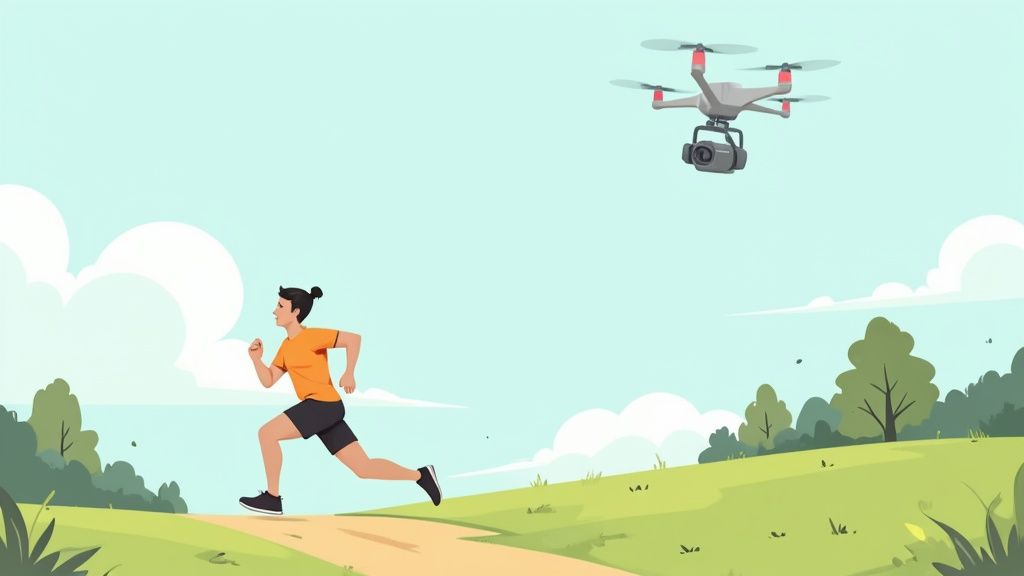
Think of a "follow me" drone as your personal, flying cinematographer. It’s a smart, robotic camera designed to lock onto a subject and film them completely on its own. Using a clever mix of GPS and AI-powered visual tracking, it can follow you without anyone needing to manually fly it. It's essentially your own aerial film crew, ready to capture your adventures from some seriously cool angles.
Your Personal AI Videographer Explained
Imagine you’re mountain biking down a twisting single track, skiing through fresh powder, or just playing in the park with your kids. Now, picture all of that captured from a stunning aerial view, with silky-smooth, cinematic shots that follow every single move you make. That’s not a scene from a movie; it’s what a drone camera that follows you makes possible.
This technology completely frees you from the controller. You get to be the star of the show instead of the one stuck behind the camera. The benefit is simple but huge: you can get dynamic, professional-looking video without lifting a finger. This opens up a whole new world for solo adventurers, athletes, and creators who used to need a dedicated camera operator to even dream of getting these shots.
Why Autonomous Tracking Is a Game-Changer
The real magic behind a "follow me" drone is its intelligent flight modes. These drones don’t just hover in place. They use sophisticated software to pull off complex maneuvers, all while keeping you perfectly centered in the frame. This automation is what turns a simple flying camera into a powerful storytelling tool.
Here’s what makes it so special:
Effortless Cinematic Shots: You can capture tricky orbiting shots, parallel tracking moves, and dramatic reveals without any manual piloting.
Focus on the Action: Athletes and adventurers can stay completely in the moment, trusting the drone to handle all the filming.
Solo Content Creation: It completely removes the need for a second person, making it possible for one individual to produce seriously polished videos.
To truly understand what these drones are capable of, it's helpful to see a quick breakdown of the core technologies that make the "follow me" magic happen.
Core Technologies in Follow Me Drones
Technology Type | How It Works | Best Use Case |
|---|---|---|
GPS Tracking | The drone follows a GPS signal from the controller or a dedicated beacon. It's like a digital leash. | Open, unobstructed areas where maintaining a set distance from the subject is key. Think boating or cycling in a field. |
Visual Recognition | The drone uses its camera and AI algorithms to identify and lock onto a subject (like a person or car) based on shape and color. | Dynamic environments with potential obstacles, where the subject might change speed or direction unpredictably. |
Sensor Fusion | This is the best of both worlds, combining GPS, visual data, and other sensors (like obstacle avoidance) for the most reliable tracking. | Fast-paced action sports like skiing or mountain biking, where you need both precision and safety. |
These systems, working together, are what allow the drone to function as a true autonomous cinematographer.
Think of it this way: A standard drone is like a camera on a tripod in the sky. A drone with follow-me technology is like having a dedicated director of photography who anticipates your movements and adjusts the shot on the fly.
This kind of smart automation goes beyond just drones. The broader conversation around the impact of AI-assisted content generation shows just how much is changing. These systems aren't just about convenience; they're fundamentally shifting how we create videos, putting advanced techniques into everyone's hands. Next, we’ll dive into exactly how this incredible tech works.
How Drone Tracking Technology Actually Works
Ever wondered how a follow-me drone stays locked onto you, gliding through the air like a personal camera crew? It’s not magic, but a brilliant combination of technologies working in sync. The two core methods powering this autonomous flight are GPS-based tracking and vision-based tracking. Each has its own strengths and is better suited for different situations.
Think of it like having two different kinds of navigators. One uses a map and coordinates (GPS), while the other uses its eyes to recognize and follow a landmark (vision). The best modern drones actually blend both approaches to create a tracking system that’s both reliable and incredibly smart.
This breakdown shows how the core components—GPS, vision sensors, and AI algorithms—all work together to make autonomous tracking a reality.
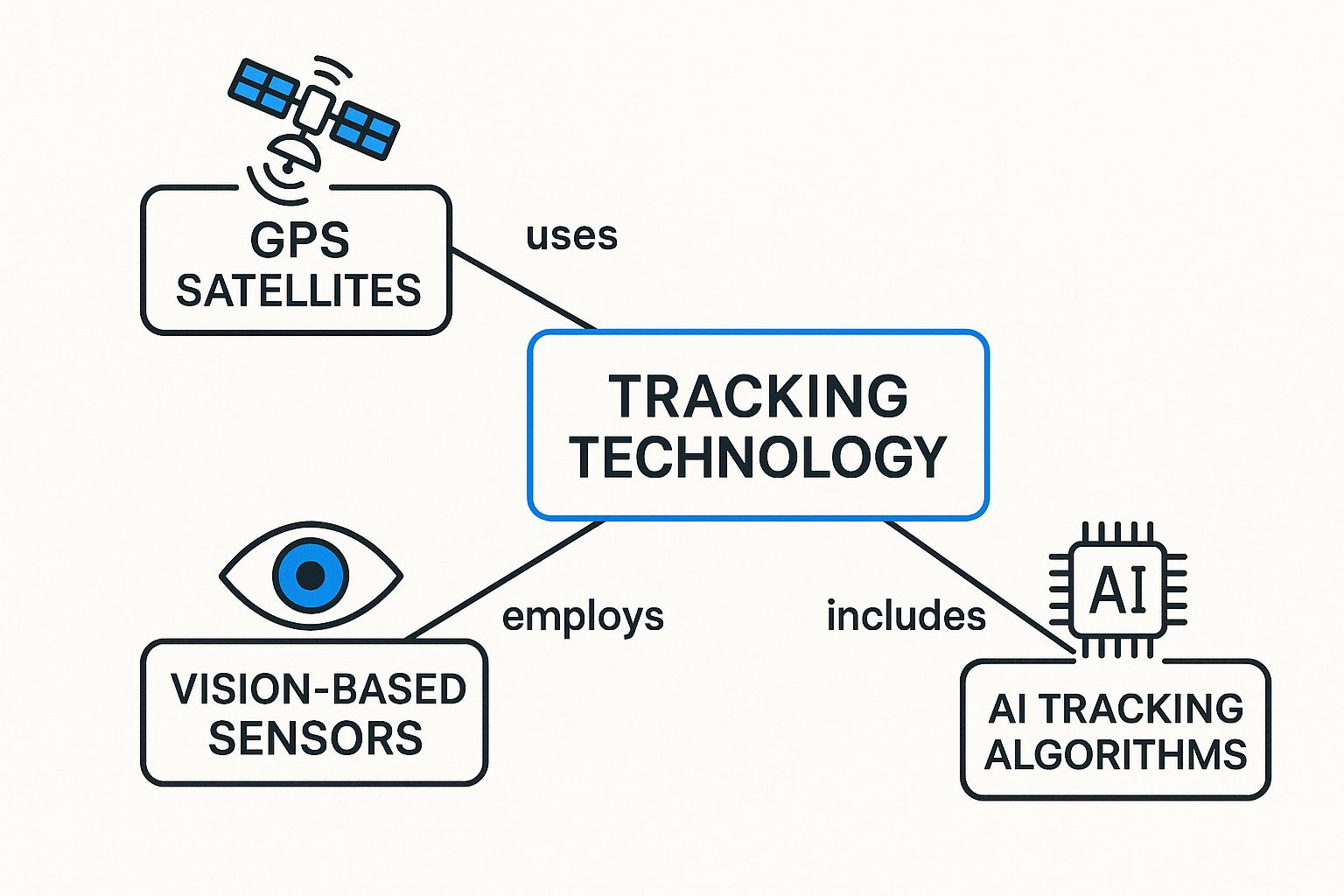
As you can see, these three pillars are deeply connected. The AI brain processes data from both satellite signals and the onboard camera to execute precise, fluid movements. This fusion is what allows a drone to not just follow, but to follow intelligently.
GPS Tracking: The Digital Leash
GPS tracking was the original “follow me” tech. It works by creating a digital connection—a virtual leash, really—between the drone and a GPS device, which is usually your remote controller or smartphone. The drone's job is simple: keep a set distance and angle from that GPS signal, no matter where it goes.
Picture yourself kayaking on a wide-open lake. With GPS tracking on, the drone follows the controller in your hand. Paddle faster, and it speeds up. Make a turn, and it mirrors you. It's incredibly reliable in open spaces where the sky is clear and satellite signals are strong.
But this method has its weak spots. It’s not very effective in places with poor GPS reception, like deep canyons or dense forests. Plus, since it’s only following a signal, the drone is completely blind to obstacles like trees or buildings unless it has a separate collision avoidance system.
Vision Tracking: The Smart Eye in the Sky
This is where things get really clever. Vision-based tracking, which you'll see marketed under names like DJI’s ActiveTrack, uses the drone's camera and powerful onboard processors to visually lock onto a subject. You just draw a box around yourself, your car, or even your dog on the controller's screen, and the drone's AI takes over from there.
This system is like advanced facial recognition, but for your entire body or vehicle. It analyzes shapes, colors, and movement patterns to build a 3D model of the subject, allowing it to predict your next move and keep you perfectly framed.
Vision tracking is the clear winner for complex environments. A drone using this method can follow you through a forest, intelligently weaving around trees while keeping you in the shot. It doesn’t need a GPS signal from a controller, so it shines where satellite reception is spotty. The jump from basic GPS to these advanced visual algorithms has been a massive leap for drone tech. Today’s best follow-me drones typically rely on both GPS for general positioning and computer vision for subject tracking, making them versatile enough for both open fields and dense urban jungles. You can find more insights on this evolution over at The Drone U.
How They Work Together
The best drones don’t make you pick one method over the other. Instead, they use a technique called sensor fusion to combine the strengths of both systems for a nearly flawless performance.
GPS Data Provides: Broad positional awareness. The drone always knows where it is globally and the general location of its target.
Vision Sensors Provide: Fine-tuned subject tracking and obstacle recognition. The camera keeps the subject framed perfectly and spots potential hazards.
AI Algorithms Process: All of this incoming data in real-time, making split-second decisions to adjust speed, altitude, and direction for a smooth, cinematic shot.
This tag-team approach ensures maximum reliability. If the visual lock is temporarily lost—say, you duck behind a large tree—the drone can use the last known GPS location to predict where you’ll reappear. This intelligent collaboration is the secret sauce behind those breathtakingly smooth tracking shots that once required a professional film crew.
What to Look For in a High-Performance Tracking Drone
So you want a drone camera that follows you, but where do you start? Not all tracking drones are built the same. While the basic idea is simple enough, the difference between a high-end model and a basic one comes down to a handful of critical features that directly impact performance, safety, and the final quality of your footage.
Think of it like buying a new camera. Any camera can take a picture, but the one with a better lens, faster autofocus, and superior low-light performance is what separates a decent shot from a stunning one. The same logic applies here—the right features take the experience from stressful to creatively liberating.
Comprehensive Obstacle Avoidance
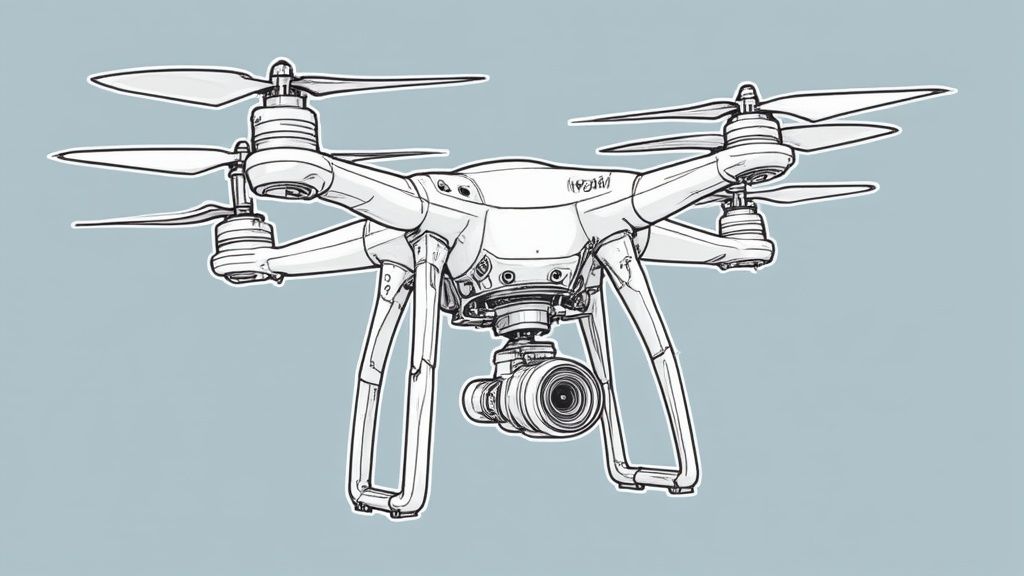
This is the big one. The single most important safety feature you need is omnidirectional obstacle avoidance. This is essentially the drone's 360-degree awareness, using a suite of sensors on its front, back, sides, top, and bottom to see and navigate around things like trees, power lines, and buildings.
A drone without it is basically flying with blinders on. Sure, it might follow you just fine in a wide-open field, but it’s a disaster waiting to happen the second you take it into a forest or near any complex structures.
A solid obstacle avoidance system is the difference between confidently flying through a dense forest and anxiously watching your expensive drone hurtle toward a tree. It’s your drone’s spatial intelligence, giving you the freedom to focus on your activity, not on babysitting the drone.
At a minimum, look for models with four-directional sensing (front, back, up, and down). The gold standard for maximum safety, however, is six-directional (omnidirectional) coverage.
Flight Time Is Your Creative Window
Battery life, plain and simple, dictates how much you can actually accomplish. A drone that taps out after only 15 minutes in the air is going to severely limit your creative shots, especially on longer activities like a hike, bike ride, or ski run. You'll end up spending more time on the ground swapping batteries than in the air filming.
Top-tier models today offer flight times of 30 minutes or more on a single battery. This longer window gives you the breathing room to:
Set up complex shots: Take your time to frame the perfect starting point without feeling rushed.
Capture longer sequences: Film an entire trail run or a full paddle down a river in one continuous take.
Fly with a safety buffer: Land with plenty of juice left, avoiding that heart-pounding stress of a low-battery warning mid-shot.
Pro tip: always spring for a "Fly More" combo or at least a couple of extra batteries. Having two or three fully charged batteries on hand turns a 30-minute flight into 60-90 minutes of real-world creative time.
Uncompromising Camera Quality
At the end of the day, a drone is a flying camera. The most advanced tracking tech in the world is pointless if the video it captures is shaky, blurry, or low-resolution. Two things are absolutely crucial here: the camera sensor itself and the gimbal that holds it.
1. The Camera SystemLook for a drone that shoots in at least 4K resolution at 30 frames per second (fps). This is the modern standard for crisp, detailed video. If you’re a creator who loves silky-smooth slow-motion, then 4K at 60fps is an even better target. The image sensor size is also a big deal—a larger sensor, like a 1-inch or 4/3 CMOS, pulls in more light, which means much better video quality across different lighting conditions.
2. The 3-Axis GimbalThe gimbal is the magic behind that buttery-smooth cinematic footage. A 3-axis gimbal is non-negotiable. It's a mechanical stabilizer that actively counteracts the drone's movements—pitch, roll, and yaw. It's the reason your video looks stable and professional, even while the drone is banking hard to keep up with you. Without it, your footage would be a chaotic, unwatchable mess. Stability and quality are the bedrock of good aerial work, and you can learn more about mastering them with our [top drone photography tips to elevate your shots](https://www.jabdrone.com/post/top-drone-photography-tips-to-elevate-your-shots).
Intelligent Flight Modes Beyond Basic Following
Finally, a truly great tracking drone comes packed with a suite of intelligent flight modes. These are pre-programmed maneuvers that let you capture incredibly complex, cinematic shots with just a couple of taps on the screen.
Orbit (Point of Interest): The drone flies a perfect circle around you or another subject, keeping the camera locked on target. This creates a dramatic, sweeping shot that’s nearly impossible to pull off manually.
Waypoints: You can actually draw a flight path on a map by setting GPS points. The drone flies the route on its own, freeing you up to focus entirely on controlling the camera for a perfectly planned shot.
Parallel (Profile): The drone flies alongside you at a consistent distance and height. It's the perfect mode for capturing side-profile action shots when you're running, cycling, or even driving.
These modes work hand-in-hand with the main "follow me" feature, elevating your videos from a simple follow-cam shot to a dynamic, multi-angle story.
How to Choose the Right Drone for Your Needs
Picking the perfect follow-me drone isn't about grabbing the priciest model off the shelf. It’s all about matching the right tech to your passion. The drone a solo hiker needs to capture vast mountain landscapes is a completely different beast from the one an athlete requires for high-speed action shots.
Think of it like choosing the right pair of shoes. You wouldn’t wear heavy hiking boots for a marathon, and you wouldn't wear feather-light running shoes to climb a rocky peak. Your drone should be a tool that's perfectly suited for the adventures you have in mind.
The Solo Adventurer and Traveler
For anyone who explores on their own, whether you're backpacking through remote wilderness or documenting your travels, portability is king. A bulky, heavy drone isn’t an asset; it's a liability. You need something small, light, and tough enough to handle being jostled around in your pack.
For this type of user, the priorities are clear:
Weight and Compactness: Look for drones that weigh under 250g. Models like the DJI Mini series are fantastic because their low weight often means fewer registration hassles in many countries, and they fold down small enough to disappear into any bag.
Decent Battery Life: You need enough flight time to get the shot without constantly stressing about your battery. Aim for 30 minutes or more so you can capture that perfect sunrise or sunset.
Reliable GPS Tracking: While advanced vision tracking is a great bonus, a solid GPS follow-me mode is usually more than enough for capturing scenic hikes or kayaking trips in wide-open spaces.
For the adventurer, a drone is a storytelling companion. It needs to be easy to launch, simple to fly, and rugged enough to bring back incredible footage from off-the-beaten-path locations—all without weighing you down.
The Action Sports Athlete
If your world involves speed—think mountain biking, skiing, snowboarding, or watersports—your needs shift dramatically. The main concern here is getting a drone that can not only keep up but also intelligently navigate a fast-moving, obstacle-filled environment. Portability suddenly takes a backseat to raw performance and safety.
Your top priorities should be:
Advanced Vision Tracking: You absolutely need a system like DJI's ActiveTrack or Skydio's legendary 360-degree collision avoidance. These AI-powered systems can actually predict your movements and actively dodge obstacles like trees and rocks while staying locked on you. The Skydio 2+ is famous for its almost magical tracking in these situations.
High-Speed Performance: Check the drone’s maximum tracking speed. It has to be faster than you are to pull off those dynamic shots from different angles.
Robust Obstacle Avoidance: This is completely non-negotiable. Omnidirectional (360-degree) sensing is critical to protect your investment when you're flying at speed through unpredictable terrain.
The Content Creator and Filmmaker
For videographers, YouTubers, and other content creators, image quality is the ultimate prize. Sure, tracking performance matters, but it’s useless if the footage isn't crisp, stable, and visually stunning. This user is often willing to carry a slightly larger and heavier drone to get that professional, cinematic look. For a deeper look at top-tier options, check out our [best camera drone that follows you buying guide](https://www.jabdrone.com/post/best-camera-drone-that-follows-you-buying-guide).
Here's what to hunt for:
Superior Camera Sensor: A larger sensor, like a 1-inch or 4/3 CMOS sensor found in models like the DJI Air 2S or Mavic 3 series, captures way more light and detail. This means better performance in all sorts of lighting conditions.
High-Resolution Video: You should be looking for at least 4K at 60fps. This gives you the flexibility to create buttery-smooth slow-motion effects. For truly professional work, 5K resolution gives you even more room to crop and edit in post-production.
Intelligent Flight Modes: Features like Orbit, Waypoints, and other cinematic presets are essential. They help you create varied, engaging shots that go way beyond a simple "follow me" clip by automating complex camera movements for a polished, high-production feel.
Different activities demand different features from a follow-me drone. What's essential for a vlogger might be overkill for a casual hiker, while a pro athlete needs tracking capabilities that others can live without.
This table breaks down which tracking features are most important for different types of users, helping you pinpoint what to look for based on what you love to do.
Drone Tracking Features by User Type
User Profile | Primary Activity | Most Important Feature | Example Drone Category |
|---|---|---|---|
Solo Traveler | Hiking, travel vlogging, scenic exploration | Portability and GPS reliability | Sub-250g Mini Drones |
Action Sports Athlete | Mountain biking, skiing, watersports | 360° obstacle avoidance & high-speed tracking | High-Performance Consumer Drones |
Content Creator | Cinematic shots, professional videography | Camera sensor size and intelligent flight modes | Prosumer/Pro Drones |
Family/Casual User | Capturing memories, park outings | Ease of use and basic subject tracking | Entry-Level Camera Drones |
Ultimately, understanding these profiles helps clarify your own needs. By identifying whether you're more of an adventurer, an athlete, or a filmmaker, you can focus your search on the drones that are truly built for your world.
Mastering Your Autonomous Drone for Better Shots
Owning a follow-me drone is just the first step; turning its footage into something truly breathtaking is a whole different ballgame. To get beyond the basic "point-and-follow" shot, you need to blend a bit of creative planning with responsible piloting. It's this combination that will elevate your clips from simple home videos to genuinely cinematic sequences, all while keeping your flights safe and legal.
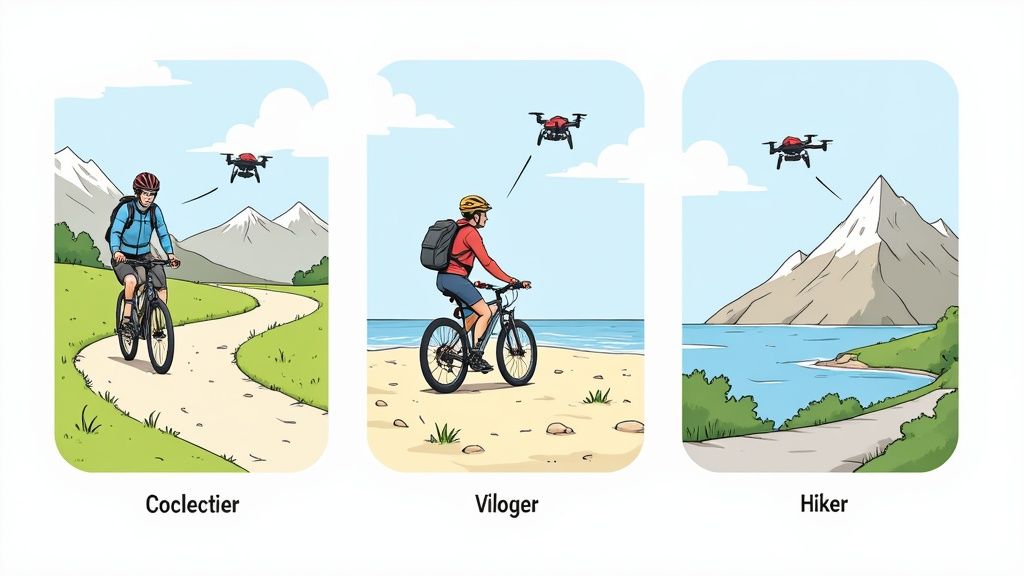
Start thinking like a director, not just the talent. Before you even think about launching, take a good look at your location. Scout for natural leading lines like a winding trail or a riverbank. Look for interesting textures, potential obstacles, and the best light. A few minutes of planning on the ground can transform a straightforward follow shot into a visually stunning journey for your viewers.
Setting the Scene for Success
Once you have a rough idea of the shot, it's time to dial in the flight settings. Don't just settle for the defaults out of the box. Playing around with the drone's distance and altitude is where the real magic happens, creating dynamic and engaging video.
Vary Your Altitude: A low-angle follow shot feels intense and fast, making it perfect for action sports. On the other hand, flying higher creates a grand, sweeping sense of scale that's ideal for showing off epic landscapes.
Adjust Your Follow Distance: Flying close to your subject creates an intimate, personal perspective. Pulling the drone further back reveals more of the environment, giving crucial context to your story.
Use the Environment: Instead of just tracking yourself across an empty field, try flying parallel to a line of trees or over a ridgeline. This adds layers of depth and motion to the frame, making the final shot far more compelling.
The best autonomous shots are a collaboration between you and your drone. You perform the action and set the creative direction; the drone executes the technical flight, allowing you to capture moments that would be impossible to film otherwise.
Flying with Safety and Responsibility
Mastering your drone isn't just about getting cool shots; it's about being a responsible pilot. These gadgets are everywhere now, and with that popularity come important regulations designed to keep everyone safe. The global drone camera market was valued at around USD 2.29 billion in 2024 and is only expected to grow, but that growth depends entirely on users flying safely.
Always stick to these core principles:
Know Your Airspace: Use an app like B4UFLY to check for flight restrictions before you take off. Never fly near airports, military bases, or over large crowds of people.
Maintain Visual Line of Sight (VLOS): This is a non-negotiable rule. You must be able to see your drone with your own eyes at all times.
Respect Privacy: Avoid flying over private property without getting permission first. What feels like an epic shot to you can feel like a serious invasion of privacy to someone on the ground.
It's also crucial to understand what your specific drone can and can't do. For instance, our DJI Mini 4 Pro review dives into its advanced obstacle avoidance systems, a feature that dramatically improves safety when flying in complex environments.
Finally, remember that the work isn't over when the drone lands. Your footage won't reach its full potential without a little post-production love. To give your final video that professional polish, it's worth learning how to sync audio with video for perfect alignment.
Where Follow-Me Drone Tech is Headed Next
The technology that powers a follow-me drone is moving at a breakneck pace. What we're seeing today is just the beginning. The horizon promises drones that are less reactive and far more predictive, turning them into genuine, intelligent partners for capturing our adventures.
Future systems are already looking beyond simply keeping a subject in the frame. The next major leap is smarter, more intuitive AI that can actually anticipate a person's movements. Think about a drone that knows you’re about to carve down a ski slope and automatically positions itself for a more dramatic, natural-looking shot without a single command. This kind of predictive brain will create smoother, more cinematic footage that feels like it was directed by a pro.
Smarter Eyes and Longer Wings
As the brains get smarter, the drone's senses and stamina are getting a major upgrade, too. Breakthroughs in sensor technology and raw processing power are leading to massive improvements in collision avoidance. This will unlock safe, high-speed tracking in seriously cluttered environments like dense forests or tight cityscapes—places where even today's best models can get tripped up.
On top of that, battery technology is finally starting to catch up, promising to extend flight times in a big way. Longer-lasting batteries mean more time in the air to nail that perfect sequence, so you won't have to keep interrupting the action to swap out power packs.
This isn't just about building a cooler gadget. It's a fundamental shift toward seamless collaboration between human and machine. Future drones will act less like tools we operate and more like autonomous partners that understand creative intent.
This rapid progress is also pushing follow-me drones into new industries far beyond personal vlogging. Regional market trends show just how diverse this growth is, with Europe’s drone camera market projected to grow at a CAGR of 14.6% through 2034, largely driven by uses in agriculture and media. The Asia Pacific region is right there with it, showing this technology is becoming a key part of global business. You can discover more about the growing global drone market to see the full picture.
This expansion from a personal hobby to an essential professional tool really hammers home the profound impact autonomous drone technology is already having.
Common Questions About Follow Me Drones
Once you’ve got your head around the tech, the practical questions start popping up, especially when you’re ready to pull the trigger on a drone that can follow you. Nailing down the answers to these common queries will help you fly with more confidence and, frankly, make a smarter buy. Let’s jump into some of the most frequent questions we hear.
Can a Drone Follow Me Through Trees?
This is the big one for anyone dreaming of epic shots in the woods or other cluttered spots. The short answer? It all comes down to the drone's obstacle avoidance system.
A basic drone with few or no sensors is a recipe for disaster here—it’ll almost certainly end up in a tree. But a high-end drone with omnidirectional (360-degree) obstacle avoidance is built for exactly this scenario. Drones like the Skydio 2+ or DJI's more advanced models use an array of cameras and sensors to create a live 3D map of their surroundings. This allows them to intelligently weave around branches and trunks, all while keeping you perfectly in the frame.
Think of it like this: a basic drone is like trying to run through a forest blindfolded. A drone with omnidirectional sensors is like having a parkour expert’s spatial awareness, able to see and react to obstacles from every angle.
Do I Need Internet for Follow Me Mode?
Nope! You don't need an internet or cellular connection for your drone’s follow-me mode to work. The whole tracking system is a self-contained loop that relies on a direct link between three key players:
GPS Satellites: Both your drone and its controller are constantly talking to GPS satellites to pinpoint their exact locations.
Radio Controller: Your drone communicates directly with the controller using a dedicated radio frequency, not Wi-Fi or cell data.
Vision Sensors: The drone’s camera and onboard computer handle all the visual tracking right there on the device.
This closed-loop system means you can head out to the most remote, off-grid locations you can think of and your follow-me mode will work just fine. For a deeper dive, check out [your guide to drone follow me mode](https://www.jabdrone.com/post/your-guide-to-drone-follow-me-mode).
How Fast Can a Follow Me Drone Fly?
Tracking speed is a huge deal, particularly if you're into action sports. How fast a drone can follow you varies a ton from one model to the next. Your entry-level drones might top out around 20-25 mph (32-40 kph), which is plenty for jogging or a casual bike ride.
But if you're looking to film some high-speed action, more advanced drones can track subjects at speeds of 40 mph (64 kph) or even faster. One crucial thing to remember: the drone's maximum flight speed listed on the box isn't the same as its maximum tracking speed. Tracking is limited by how fast the processor can analyze the video feed and keep up. Always double-check the specific follow-me speed if you plan on filming anything fast.
At JAB Drone, we provide the expert insights you need to choose the right gear and master your aerial videography. Explore our in-depth reviews and guides at https://www.jabdrone.com.
Comments