


Best Drone for Aerial Photography Your Ultimate Guide

Updated: Sep 16, 2025
For professionals who live and breathe aerial photography, the DJI Mavic 3 Pro and its multi-lens system is in a class of its own. Enthusiasts looking for that perfect blend of performance and portability will feel right at home with the DJI Air 3, while beginners can jump right in and get incredible shots with the super-intuitive DJI Mini 4 Pro.
Finding the Best Drone for Your Creative Vision
Picking the right drone goes way beyond just comparing spec sheets. It’s really about finding the right tool to bring your creative ideas to life. What a landscape photographer needs to capture sprawling, epic vistas is completely different from what a real estate professional requires for crisp, stable property shots.
This guide cuts through the marketing fluff to zero in on what actually matters for taking killer photos from the sky. We're going to break down the essential components that make an aerial camera truly great, so you can make a choice you feel confident about.
These are the things that really count:
Sensor Performance: How the drone’s camera handles light and captures fine detail, especially when conditions aren't perfect.
Flight Stability: Its ability to hang steady in the wind is non-negotiable for getting sharp, blur-free images.
Intelligent Features: Automated flight modes that take the guesswork out of complex cinematic movements and tracking shots.
The drone market is absolutely booming, with commercial sales expected to hit USD 12.6 billion by 2025. All this growth means a ton of options, making it more important than ever to understand the subtle differences that separate a good drone from a great one.
To help you get started, we've put together a quick-look table of our top picks. It’s a great starting point, but for a much more detailed breakdown, be sure to check out our practical guide on how to choose a drone.
Remember, the best drone is just a tool—one that should feel like an extension of your own creativity. At the end of the day, it's your skill in mastering different camera angles that will truly make your work stand out.
Top Drone Picks for Every Photographer
To make things even simpler, here’s a quick-look summary table that breaks down our top recommendations based on your experience level and what you want to shoot. It’s a handy reference for seeing which drone might be the best fit for your needs at a glance.
User Level | Recommended Drone | Best For | Key Feature |
|---|---|---|---|
Professional | DJI Mavic 3 Pro | Unmatched versatility and image quality | Triple-camera system |
Enthusiast | DJI Air 3 | Balancing power and portability | Dual-camera setup |
Beginner | DJI Mini 4 Pro | Easy flying and excellent photos | Vertical shooting and obstacle sensing |
Whether you're a seasoned pro demanding the absolute best image quality or a newcomer just starting to explore the world from above, there’s a drone on this list that will help elevate your photography. The key is matching the drone’s strengths to your personal or professional goals.
Decoding the Specs That Matter for Image Quality
When you're picking a drone for serious photography, it's easy to get lost in the marketing hype. The spec sheet can look like a foreign language, but honestly, only a handful of numbers truly impact the quality of your photos and videos. Let's cut through the noise and focus on what actually creates a stunning image.
Most people get fixated on megapixels, but that number is often misleading. A drone with a sky-high megapixel count but a tiny sensor will almost always produce worse images than a drone with fewer megapixels on a bigger sensor. Why? Because a larger sensor physically captures more light—the single most important ingredient for clean, vibrant, and detailed photos.
Sensor Size: The Real MVP
Think of a camera sensor as the canvas for your aerial masterpiece. A larger canvas allows an artist to add more detail and subtlety, right? It's the same principle here. A larger sensor has more surface area to gather light, which directly translates to better performance in tricky lighting, richer colors, and a wider dynamic range.
That dynamic range is key; it's what lets you capture detail in both the bright, blown-out sky and the dark shadows on the ground in a single shot. For a much deeper dive on this, our guide on understanding drone sensors and camera capabilities breaks it all down.
Beyond the Basics: Shutter and Codecs
While the sensor is the star of the show, a couple of other features play crucial supporting roles. Depending on what you shoot, these can be absolute game-changers.
Mechanical vs. Electronic Shutter: Ever seen a photo where a fast-moving object looks weirdly bent or skewed? That’s "rolling shutter," a common problem with electronic shutters. A mechanical shutter, which you’ll find in higher-end drones, physically opens and closes, freezing motion perfectly. It’s a must-have for capturing sharp images of moving subjects like cars, boats, or wildlife.
Video Codecs (H.265 vs. Apple ProRes): If you're a videographer, the codec is everything. It determines how much color and image data is stored in your video file. Standard codecs like H.265 are fine for everyday use, but professional formats like Apple ProRes record an enormous amount of information. This gives you incredible freedom in post-production to push your colors, adjust exposure, and grade your footage without it falling apart.
Key Takeaway: Stop chasing megapixels. A large sensor is the foundation of great image quality. From there, if you shoot anything that moves, a mechanical shutter is non-negotiable. And for serious video work, look for advanced codecs that give you room to be creative in the edit. These are the specs that make a real-world difference.
Comparing Top Drones for Aerial Photographers
Going beyond a simple spec sheet is the only way to truly understand how a drone performs. You have to put it in the situations aerial photographers face every single day. Let's pit the top contenders—the DJI Mavic 3 Pro, DJI Air 3, and Autel EVO Lite+—against each other to see how they handle the pressure, from tricky low-light shoots to nailing those buttery-smooth cinematic flight paths.
This chart gives you a quick visual breakdown of the maximum flight time and price for each of our top picks.
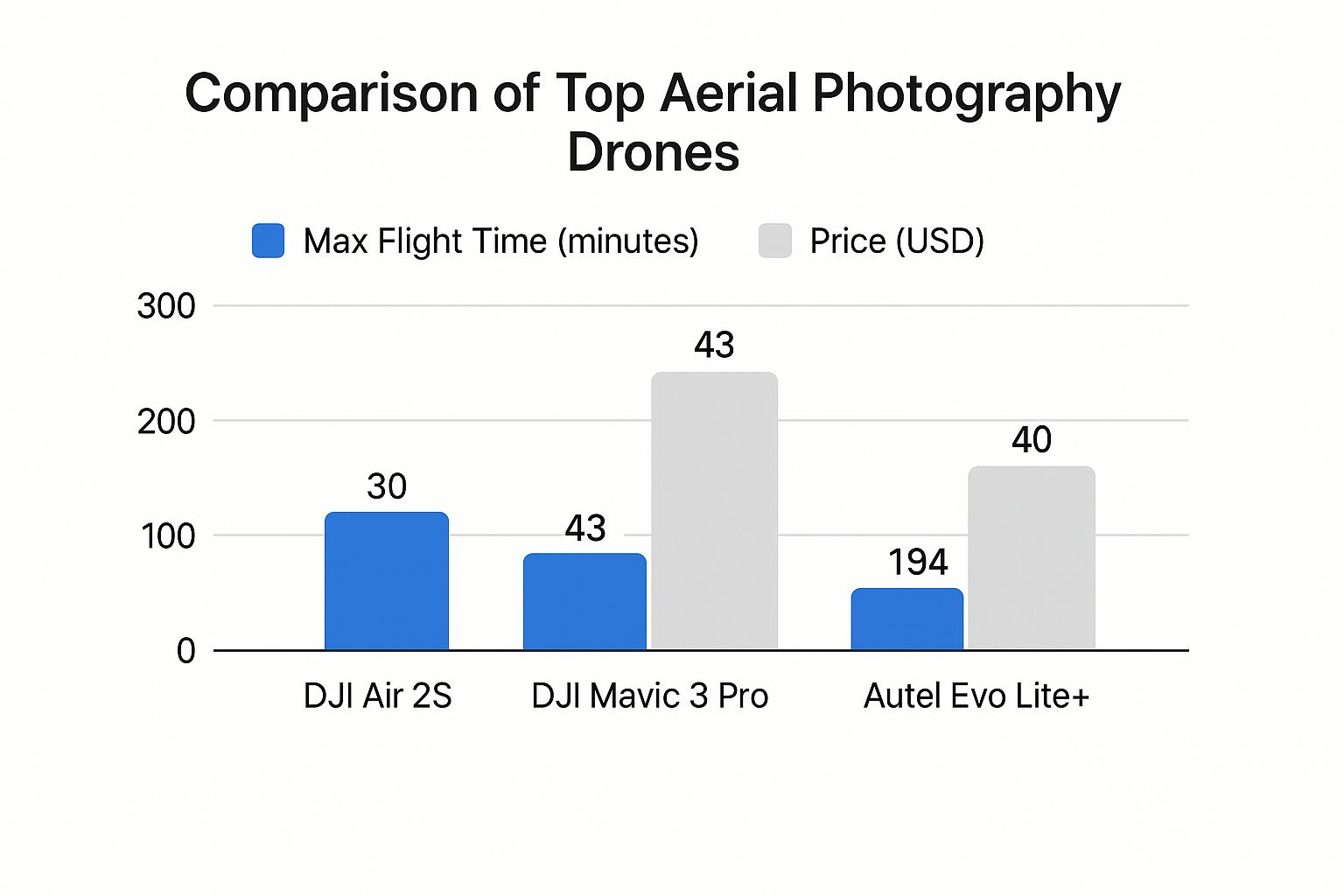
As you can see, the DJI Mavic 3 Pro sits at the top in terms of price, but both it and the Air 3 offer a serious advantage in flight time compared to the Autel EVO Lite+.
Low-Light and Golden Hour Performance
When the sun starts to dip, a drone's sensor becomes everything. It's the ultimate test of its ability to manage digital noise and hang onto all that crucial detail hiding in the shadows.
The DJI Mavic 3 Pro is the undisputed king in this arena. Its massive 4/3 CMOS Hasselblad main camera is a light-gathering beast, producing incredibly clean and rich images, even as the last bit of twilight fades. If you live for shooting during golden hour, this drone delivers pro-level results with barely any noise to clean up in post.
Right on its heels is the Autel EVO Lite+, a seriously strong competitor with its impressive 1-inch sensor and adjustable aperture. It gives you fantastic dynamic range and precise control over your depth of field, making it a brilliant tool for capturing those dramatic, fiery sunsets. While it can't quite match the sheer light-sucking power of the Mavic 3 Pro's main camera, it consistently punches above its weight.
The DJI Air 3 also holds its own with dual 1/1.3-inch sensors. They might be smaller individually, but DJI's image processing magic does a phenomenal job of churning out clean, usable footage. It's an amazing option for enthusiasts who crave great low-light performance without dropping professional-grade cash. For a deeper dive into how various models stack up, our guide lets you compare drones of 2025 and see the best models reviewed.
Critical Differentiator: The Mavic 3 Pro's larger primary sensor gives it a distinct advantage in preserving shadow detail and color fidelity in challenging low-light conditions, a crucial factor for professional landscape photographers.
Technical Specifications Side-by-Side Comparison
When you're trying to decide, sometimes just seeing the raw numbers next to each other makes all the difference. This table breaks down the key technical specs for each of our top contenders, making it easy to compare things like sensor size, video resolution, and flight time at a glance.
Feature | DJI Mavic 3 Pro | DJI Air 3 | Autel EVO Lite+ |
|---|---|---|---|
Main Sensor | 4/3 CMOS | 1/1.3-inch CMOS | 1-inch CMOS |
Max Video Resolution | 5.1K/50fps | 4K/100fps | 6K/30fps |
Aperture | f/2.8-f/11 (Main) | f/2.8 (Wide), f/2.8 (Tele) | f/2.8-f/11 |
Max Flight Time | 43 minutes | 46 minutes | 40 minutes |
Transmission Range | 15 km (O3+) | 20 km (O4) | 12 km (SkyLink) |
Obstacle Sensing | Omnidirectional | Omnidirectional | Front, Rear, Downward |
Looking at the data, you can clearly see the trade-offs. The Mavic 3 Pro offers the best sensor, the Air 3 boasts the longest range and flight time, and the EVO Lite+ brings a high-resolution 6K sensor into the mix. Each drone excels in a different area.
Cinematic Movements and Automated Flight
Getting those smooth, sweeping cinematic shots often comes down to precise, repeatable flight paths. This is where automated features like subject tracking and waypoint missions stop being conveniences and become essential tools, especially for solo operators.
The DJI ecosystem, especially with the Mavic 3 Pro and Air 3, offers the most polished automated flight experience out there. Their ActiveTrack 5.0 and Waypoint systems are incredibly reliable, letting the drone fly complex routes or follow subjects on its own while you focus 100% on framing the shot. The Mavic 3 Pro’s omnidirectional obstacle sensing adds a huge layer of confidence, making it much safer to fly in tricky environments.
The Autel EVO Lite+ has solid subject tracking that does a good job with human subjects. The catch? It lacks the multi-directional obstacle avoidance of the DJI models, with sensors only on the front, rear, and bottom. This means you have to be much more careful when tracking subjects near side obstacles, like in a dense forest or an urban area.
Real-World Usability and Lens Versatility
Beyond just the raw image quality, the camera system's practicality in the field makes a massive difference. This is where the DJI Mavic 3 Pro truly sets itself apart from the competition.
Its one-of-a-kind triple-camera system delivers creative freedom that's hard to beat. You get a world-class wide-angle lens, a 3x medium telephoto, and a 7x telephoto. This setup lets you instantly switch perspectives, going from a huge landscape to an isolated detail miles away, all without sacrificing quality. For dynamic storytelling, it’s an absolute game-changer.
The DJI Air 3 offers a simplified but still powerful take on this idea with its dual-camera system (wide and 3x telephoto). This gives you a major creative boost over single-lens drones, allowing for compression and parallax effects that used to be reserved for the most expensive models. It's the perfect sweet spot between versatility and portability.
The Autel EVO Lite+, on the other hand, is all about perfecting a single, brilliant lens. Its high-quality 1-inch sensor and variable aperture give incredible control to photographers who prefer to "zoom with their feet" and demand the absolute best quality from one focal length. It’s a classic approach that rewards thoughtful, deliberate composition.
How to Choose a Drone for Your Photography Niche
The idea of a single "best" drone for aerial photography is a myth. The right tool is the one that fits your specific creative work like a glove. Whether you’re shooting vast landscapes or clean architectural lines, a drone's features have to line up with the real-world demands of your job.
Choosing the right drone isn't about getting the most features; it's about getting the right features. This practical mindset ensures you invest in a tool that actually makes your work better, not one loaded with tech you'll never touch. Let’s look at what that means for three different photography specialties.
For Landscape Photographers
If you spend your time capturing the raw beauty of nature, your drone needs to be a tough, dependable partner, especially when you're miles from anywhere. You absolutely need a model with excellent wind resistance—something that can hold its own against 25-30 mph gusts on a mountain ridge or a windy coastline.
Just as critical is a camera sensor with a wide dynamic range. This is what allows you to pull incredible detail out of a single shot, from the bright highlights in the clouds to the deep shadows in a forest below. A drone with solid auto-exposure bracketing is also a must-have for creating those jaw-dropping HDR images later on.
For Real Estate and Architectural Work
Precision is everything in real estate and architectural photography. For this kind of work, you need a drone that combines unshakable hovering stability with a high-quality, distortion-free wide-angle lens. Solid GPS and vision-based positioning systems are non-negotiable for holding a perfectly steady position to get those crisp, clean shots of a property.
This is where automated flight modes really shine. Features that let you program smooth, repeatable flight paths are perfect for creating slick, professional property tours. You'll also want a camera that offers extensive exposure bracketing (think 5 or 7 shots). This is essential for blending exposures to perfectly light both the interior and exterior of a home in a single, polished image.
When it comes to real estate, the name of the game is consistency. A drone that can pull off precise, repeatable movements and capture clean, bracketed shots is far more valuable than one with a dozen cinematic tricks you'll never use.
The demand for high-quality aerial imagery is booming, and that's driving some serious innovation. The global aerial imaging market was valued at USD 3.4 billion in 2024 and is expected to hit USD 8.24 billion by 2030—a clear sign of just how vital this tech has become. You can dig into more of this data over at Precedence Research.
For Cinematic Storytellers
Filmmakers and videographers play by a completely different set of rules. For cinematic projects, total creative control over the final image is what matters most. That means hunting for a drone packed with advanced video capabilities.
Here’s what you should be looking for:
Logarithmic Color Profiles (D-Log, F-Log): These "flat" profiles capture a massive amount of data, giving you the ultimate flexibility to color grade and stylize your footage in post-production.
Variable Aperture: Being able to change your f-stop on the fly gives you direct control over depth of field and exposure, which is key to achieving that professional, cinematic look.
High Bitrate Recording: A higher bitrate means more data is being captured every second. The result is cleaner, richer video with far fewer ugly compression artifacts.
For a filmmaker, the best drone is basically a flying cinema camera. Image customizability is king, and everything else comes second.
Exploring Advanced Drones for Commercial Projects
When your aerial photography work starts tackling large commercial projects, the prosumer drones you’re used to just might not cut it. They often lack the endurance or payload capacity needed for serious jobs. This is exactly where advanced hybrid systems come in, giving you a powerful mix of a fixed-wing’s long flight time with a multi-rotor’s ability to hover and maneuver.
These aren't your everyday camera drones. They're built for demanding work—think large-scale construction site surveying, up-close industrial inspections of wind turbines, or precision agriculture missions that span hundreds of acres. Their real advantage is flight time. Many can stay airborne for well over an hour, which makes a huge difference in efficiency on the ground.
Balancing Power and Practicality
Hybrid drones are at the forefront of commercial aerial imaging today. The ability to carry heavier, more specialized payloads like thermal or LiDAR sensors unlocks entirely new services you can offer. This kind of versatility is a big reason they're seeing such rapid adoption in the professional world.
But all that advanced capability comes with a few trade-offs. The initial cost for one of these systems is substantially higher than even a top-of-the-line prosumer model. They also require a higher level of skill to fly safely and effectively, meaning there's often a much steeper learning curve for pilots.
This isn't just a niche trend; it’s a major market shift. Hybrid drones are projected to grow at a CAGR of 20.4% between 2025 and 2035, outpacing traditional multirotors because of their superior flight endurance and operational flexibility. You can find more insights on this growing market over at FactMr.com.
For any business looking to expand its services, it’s critical to understand what you're getting into. While the investment is significant, the potential return on highly specialized, large-scale projects can be massive. Our guide to the top drones in commercial use for 2025 gives you more perspective on this evolving field. Picking the best drone for aerial photography at this level is all about matching the aircraft’s unique strengths to specific, high-value commercial jobs.
Making Your Final Decision with Confidence
Choosing the right drone for your aerial photography ultimately boils down to a very personal decision: what are your creative goals, and what's your budget? We’ve dived deep into the specs and real-world performance of the top contenders. Now it's time to translate all that data into a choice that truly elevates your work.
Our head-to-head comparisons point to three incredible drones, each a champion in its own right. For the professional who needs it all—uncompromising image quality and the creative freedom to reframe on the fly—the DJI Mavic 3 Pro is the undisputed king. That triple-lens system isn't a gimmick; it's a genuine game-changer out in the field.
Finding Your Perfect Fit
For the serious enthusiast looking for that sweet spot between raw power and go-anywhere portability, the DJI Air 3 is a fantastic package. It brings professional-grade features, like its dual-camera setup, into a much more travel-friendly and accessible drone.
On the other hand, the Autel EVO Lite+ stands out as a phenomenal value. It delivers a gorgeous 1-inch sensor and an adjustable aperture, making it a dream for photographers who want to master a single, exceptional lens without breaking the bank.
The best choice isn't always the most expensive model. It's the drone whose features directly solve your creative problems and align with the type of photography you do most often.
To help you lock in your decision, ask yourself these final questions:
Primary Goal: Are you shooting for professional versatility, travel-friendly power, or the absolute best image quality your budget can buy?
Key Subjects: Do you primarily capture vast landscapes that demand incredible dynamic range, or is your focus on architecture that requires pinpoint precision and varied focal lengths?
Future Growth: Do you see your needs expanding into more complex video projects or commercial work down the road?
Answering these honestly is the key to investing with confidence.
Frequently Asked Questions About Photography Drones
Jumping into the world of aerial photography can feel overwhelming, and it's natural to have questions, even if you’ve been flying for a while. Let's tackle some of the most common things pilots ask, so you can make a smarter choice when picking up your next drone.
What Camera Spec Is Most Important for Photos
It's easy to get caught up in the megapixel race, but the real secret to stunning aerial photos is sensor size. Think of it this way: a larger sensor, like a 1-inch or 4/3 CMOS, is like having a bigger net to catch light.
This is a game-changer. More light means cleaner, less noisy images, especially when shooting at dawn or dusk. You also get a much wider dynamic range, which is crucial for capturing all the details in a high-contrast scene—from the brightest parts of the sky to the darkest shadows on the ground, all in one shot.
Do I Need a License to Fly a Photography Drone
This really comes down to where you are and what you're doing with the drone. The rules can vary wildly from one country to another.
Here in the United States, for instance, flying for personal enjoyment is treated very differently from flying for commercial work. If you plan to sell your photos or get paid for your flight services, you’ll need to get your Part 107 certificate from the FAA. Always, always check the latest regulations from your local aviation authority before you send your drone up.
Key Insight: Don't get too hung up on the maximum flight time printed on the box. Real-world conditions—wind, cold temperatures, and aggressive flying—will always cut that number down. Smart planning and having extra batteries will serve you far better than an extra five minutes of advertised air time.
How Much Flight Time Is Enough for Photography
While more is always nice, a solid 25-30 minutes of flight time per battery is a fantastic sweet spot for most photo shoots. It gives you plenty of time to fly out to your spot, get your composition just right, and try a few different angles without feeling the pressure of a dying battery.
The real trick to extending your time in the field isn't finding a drone with a single massive battery. It's about being prepared. Carry a few fully charged spares and, more importantly, have a clear plan for the shots you want to capture before you even take off.
Here at JAB Drone, we're all about giving you the expert insights and honest reviews you need to own the skies. Dive into our detailed guides and find the perfect drone for you today at https://www.jabdrone.com.
Comments