


Part 107 Drone License Cost: Get the Latest Fees & Tips

Updated: Aug 15, 2025
So, you’re looking to get your Part 107 drone license and are probably wondering what it's going to cost. The short answer is that your total investment will likely land somewhere between $180 and $700, maybe a bit more.
This isn't a one-size-fits-all number. Your final cost really hinges on how you decide to tackle the training needed to pass the certification exam.
Breaking Down the Part 107 Costs
Think of it like getting any professional certification. You have the mandatory, must-pay fees, and then you have the optional study materials that make sure you actually pass. You could just pay the $175 to sit for the FAA Aeronautical Knowledge Test and hope for the best, but that's a risky bet.
A smarter approach is to invest a little in quality training upfront. This way, you avoid the headache and extra cost of having to retake the exam. We'll break down exactly what's required versus what's recommended, so you can build a budget that makes sense for you.
Here's a quick overview of the main costs you'll encounter on your path to becoming a certified pilot.
Part 107 License Cost At a Glance
This table gives you a snapshot of the primary expenses, separating the non-negotiable fees from the optional ones that can vary widely.
Cost Component | Type | Estimated Cost Range |
|---|---|---|
FAA Knowledge Test Fee | Mandatory | $175 (per attempt) |
TSA Background Check | Mandatory | $0 (Included with exam fee) |
Online Training Courses | Optional | $50 - $500+ |
Study Guides & Books | Optional | $20 - $60 |
Practice Exams | Optional | $15 - $75 |
License Renewal | Mandatory (every 24 months) | $0 (Free online training) |
As you can see, the only fixed cost you absolutely can't avoid is the exam fee itself. Everything else comes down to your personal learning style and how prepared you want to be on test day.
The Key Expenses Explained
Let's dig a little deeper into the main factors that will determine your final bill. Planning for these upfront will save you from any financial surprises down the road.
The Exam Fee: This is the non-negotiable $175 you'll pay directly to the testing center to take the FAA exam.
Study Materials: Here’s where the costs vary the most. You can find free study guides from the FAA, but most aspiring pilots opt for a paid online course to get a more structured learning experience.
Drone Registration: It's a small fee ($5 per drone), but it's required for any drone you plan to fly commercially.
By understanding these pieces individually, you can put together a budget that fits your goals. Whether you’re a self-studier on a shoestring budget or someone who wants a comprehensive course to guarantee a pass, you can map out a clear financial path to getting certified.
Understanding the Mandatory FAA Fees
Before you even start thinking about training courses or study guides, there are two mandatory costs from the Federal Aviation Administration (FAA) that you simply can't avoid.
Think of these as the cover charge for getting into the world of professional drone operations. They’re the absolute baseline for your total Part 107 drone license cost.
The Part 107 Knowledge Test Fee
First up is the big one: the fee for your Part 107 Aeronautical Knowledge Test. This is the official exam you have to pass to prove you know the rules of the sky. It's a critical step that covers everything from airspace classifications and weather patterns to the fine print of drone regulations.
As of this year, taking the 60-question Part 107 exam will set you back $175. This is paid directly to the FAA-approved testing center where you schedule your test, and it's per attempt, so you want to make sure you're ready to pass on the first try.
The Drone Registration Fee
The second mandatory fee is much smaller but just as important. Every drone you plan to fly for commercial work has to be registered with the FAA.
This registration is basically a license plate for your drone, connecting the aircraft back to you. The whole process is pretty simple and can be done online through the FAA's DroneZone portal.
The registration fee is $5 per drone, and it's good for three years. It’s a small price for a crucial piece of compliance, ensuring every commercial drone flying in our national airspace is accounted for.
Keep in mind, this fee applies to each drone in your fleet. If you're building a business with multiple aircraft, each one needs its own registration. Skipping this step can lead to some pretty hefty penalties. You can find a more detailed breakdown of the drone pilot license cost in our complete guide.
Investing In Training and Study Materials
Beyond the fixed exam fee, the biggest variable in your total Part 107 drone license cost is how you decide to study. This is where your investment can swing from practically nothing to several hundred dollars, all depending on your learning style and how prepared you want to be.
Think of it like learning a new skill. You could go the library route and teach yourself, or you could hire a personal tutor. Both can get you there, but one path is designed to be faster and boost your odds of getting it right the first time. The right training makes all the difference on exam day.
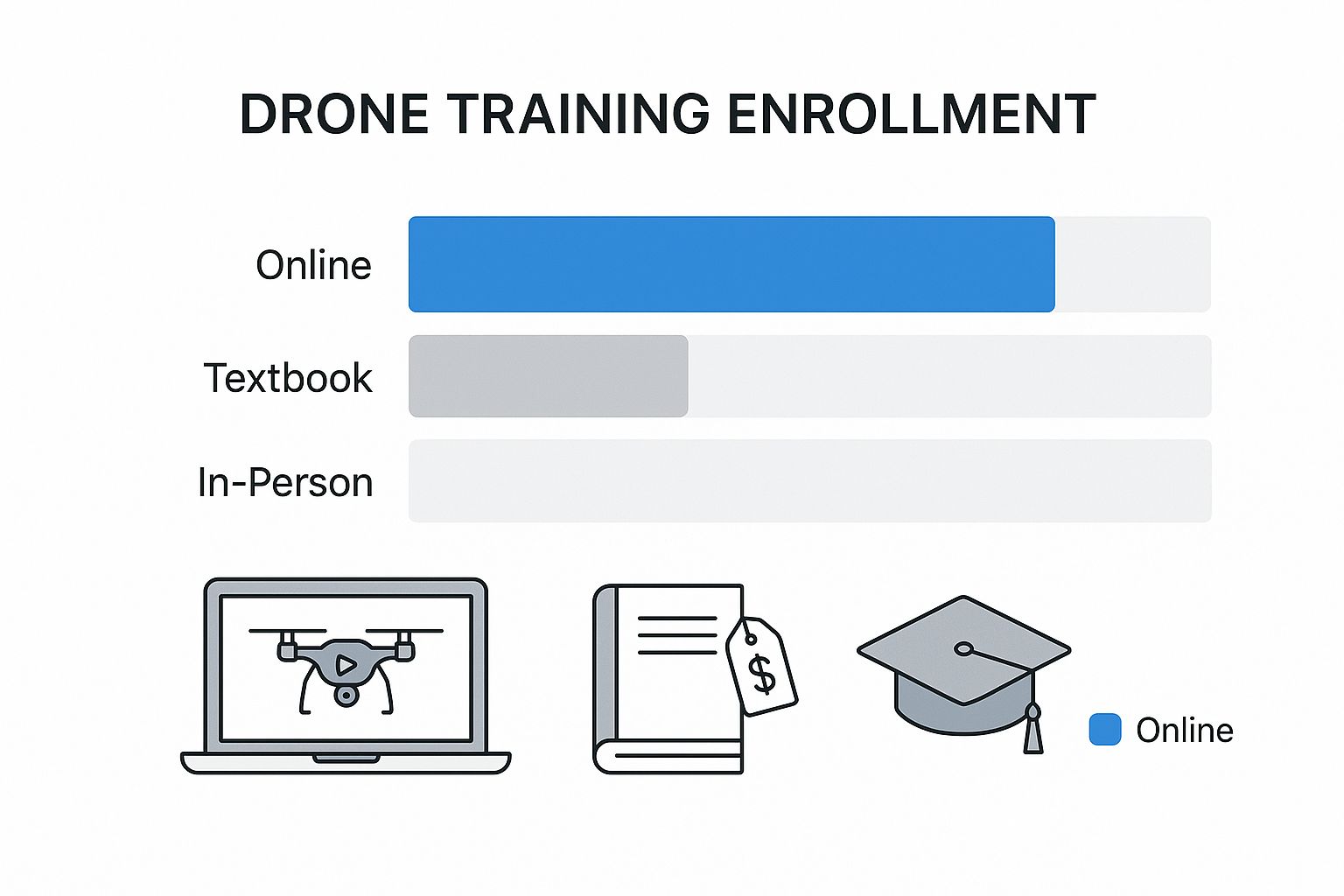
As you can see, most aspiring pilots mix and match—combining self-study with structured online courses to really lock in the knowledge.
Your Training Options
Your first option is hitting the books yourself. This means digging into the free materials the FAA provides. It’s definitely the most budget-friendly path, but it takes a ton of self-discipline. You have to be willing to piece together some pretty complex aeronautical concepts on your own, which can feel overwhelming if you're new to all this.
On the other end of the spectrum, you have paid online courses and even in-person workshops. These programs lay everything out for you with a clear curriculum, practice exams, and instructors you can actually talk to. They add to the upfront cost, sure, but they can save you money in the long run by helping you avoid a pricey exam retake.
To get a feel for what you'll be studying, check out our complete Part 107 study guide.
Choosing the right training method is a personal decision that balances your budget against your learning style. To make it easier, here's a quick breakdown of the most common paths people take.
Comparing Part 107 Training Options
Training Method | Typical Cost | Pros | Cons |
|---|---|---|---|
Self-Study (FAA Materials) | $0 | Completely free; work at your own pace | Requires high self-discipline; no instructor support; can be overwhelming |
Online Courses | $150 - $500 | Structured curriculum; practice exams; expert instruction; higher pass rates | Higher upfront cost than self-study |
In-Person Workshops | $500 - $700+ | Hands-on training; direct instructor interaction; networking opportunities | Most expensive option; less flexible scheduling |
Study Apps & Books | $20 - $100 | Affordable; good for supplemental review; portable and convenient | May not be comprehensive enough on their own; lack of instructor feedback |
Ultimately, the best choice is the one that gets you to pass the exam confidently. While paid courses have a cost, their structured format and expert guidance significantly increase the chances you'll pass on your first attempt, which is the real money-saver.
It's also worth noting that your investment in drone education doesn't just stop at the license. For those looking at a broader career in aviation, understanding things like [flight school insurance](https://wexfordis.com/2025/07/06/flight-school-insurance/) can provide a much wider financial picture of the industry.
Putting It All Together: What's Your Total Drone License Investment?
Alright, let's crunch the numbers and figure out what your total financial commitment will look like. The final Part 107 drone license cost isn't a single, fixed price. It’s more like a personalized budget that starts with a couple of must-haves and then adds in your chosen study plan.
Think of it like building a new toolkit. Everyone needs the essential wrench—in this case, the $175 FAA exam fee. After that, you decide which tools will help you get the job done right. Are you going to self-study for free, or will you invest around $200 in a solid online course to make sure you pass on your first attempt?
Your total initial investment will fall somewhere on that spectrum, from the absolute bare minimum to a more complete, guided package.
Estimating Your Initial Outlay
To give you a clearer picture, let's walk through two common pilot scenarios:
The DIY Budget Pilot: This person is focused on keeping costs down. Their biggest expense is the $175 exam fee. They might add another $25 for a highly-rated study guide or a practice exam app. All in, they're looking at a total investment of about $200.
The Career-Focused Pilot: This pilot wants to maximize their chance of success from the get-go. They'll invest in a structured online course for $250. When you add the $175 exam fee, their total comes to $425.
The Best Part: Long-Term Costs
Once you've earned your license, keeping it active is surprisingly affordable. Your Part 107 certificate is good for 24 months. To renew it, you no longer have to pay for and retake the initial knowledge test.
Instead, the FAA now requires you to complete a free online recurrent training course every two years. That’s right—the long-term cost to maintain your license is $0, which makes your initial investment an even better deal over time.
This free renewal process turns the Part 107 license into a one-time investment that can open doors to professional gigs for years to come, all with practically zero ongoing expense.
Is the Part 107 License a Worthwhile Investment?
After running the numbers, the big question is still on the table: Is the Part 107 drone license cost actually worth it? The answer becomes a lot clearer when you stop thinking of it as just another expense and start seeing it for what it is—an investment in a valuable, high-demand professional skill.
This certification is your golden ticket to legally making money with a drone. It swings open the doors to a whole world of career opportunities that are completely off-limits to recreational pilots. And trust me, the demand for certified operators is blowing up across some seriously lucrative industries.
Unlocking Your Earning Potential
We're talking about way more than just snapping a few aerial photos. Certified pilots are the ones getting hired for sophisticated jobs that command professional paychecks. This is where that initial investment really starts to pay dividends.
Some of the hottest fields looking for pilots right now include:
Real Estate Photography: Agents need those stunning aerial shots and video tours that make properties pop.
Construction Surveying: Think mapping job sites, tracking project progress from above, and running safety inspections.
Agricultural Analysis: Farmers are using drones with specialized sensors to check on crop health and boost their yields.
Cinematic Videography: This is the cool stuff—capturing dynamic, high-energy footage for movies, commercials, and marketing campaigns.
Every single one of these gigs requires the legal authority that only a Part 107 license gives you. If you're still curious, we break down exactly **why you need a 107 license to fly a drone commercially** in another one of our articles. This piece of paper is the key that unlocks the door.
The financial return on this investment can be massive. Getting certified transforms a hobby into a real income stream, giving you the chance to build a full-time career or a profitable side hustle.
The economic data backs this up, showing that those upfront costs are often earned back pretty quickly. Figures gathered over two years show that certified drone pilots in the U.S. can pull in annual incomes anywhere from $25,000 to $105,000. On an hourly basis, operators are typically making between $13 and $50, though that can change based on your experience, what you specialize in, and where you're located.
Answering Your Top Questions About Part 107 Costs
When you're looking to get your Part 107 license, a few questions always seem to pop up about the money side of things. Let's get those answered so you can map out your budget without any guesswork.
Knowing what to expect financially removes a lot of the stress, letting you focus on what really matters: acing the exam.
What Happens If I Fail the Exam?
First off, failing the Part 107 exam isn't the end of the road, but it does add to your total Part 107 drone license cost. If you don't pass on the first try, you'll have to pay the $175 testing fee again to give it another shot.
The FAA makes you wait 14 days before you can book a new test date. Honestly, this is a blessing in disguise. It gives you two solid weeks to go back, figure out where you went wrong, and really nail down the material before stepping back into the testing center.
How Long Is the Part 107 Certification Valid?
Your Part 107 Remote Pilot Certificate stays valid for 24 calendar months. The best part? Keeping it active is now easier and cheaper than ever.
When it's time to renew, you no longer have to go back to a testing center. Instead, you just have to complete a free online recurrent training course that the FAA provides. This means the ongoing cost to keep your license current is a grand total of $0.
Are There Any Hidden Costs I Should Know About?
For the most part, the expenses are pretty straightforward: the exam fee, drone registration, and any training you decide to buy. But there are a few other things that can sneak up on you if you're not prepared.
Here are a couple of things to keep on your radar:
Drone Insurance: While you don't need it to get licensed, having liability insurance is just plain smart for any commercial pilot.
Travel Costs: Don't forget to factor in the gas and time it takes to drive to your local FAA-approved testing center.
Software and Apps: As you get more advanced, you might want flight planning or data processing software, which can come with subscription fees.
The biggest "hidden cost" is almost always having to retake the exam. Investing in good training from the start is the smartest way to sidestep that extra expense and keep your total budget predictable.
For a deeper look at budgeting everything out, check out our complete guide on the [cost of a drone pilot license and affordable breakdown tips](https://www.jabdrone.com/post/cost-of-drone-pilot-license-affordable-breakdown-tips).
Ready to dive deeper and stay ahead in the world of drone technology? JAB Drone is your go-to resource for expert reviews, industry news, and comprehensive guides. Visit us at https://www.jabdrone.com to join our community and elevate your flying experience.
Comments